Backyard Pond Ideas for Every Yard and Budget
Think a backyard pond means endless algae scrubbing and a cloud of mosquitoes every evening? That was my worry too, right up until I sank a half-barrel by the patio and watched it turn into the calmest corner of the yard. A small water feature is one of the easiest ways to pull birds, dragonflies, and a little bit of quiet into a space you already own.
You don’t need acreage, either. A container pond on a balcony can feel like a pocket-sized wetland, while a roomy lot has space for a koi pond deep enough to overwinter fish. This guide walks through backyard pond ideas for every space and style, then gets into the practical side: where to dig, how to build the basin, what to plant, which fish survive, and how to keep the water clear through all four seasons.
As an Amazon Associate, Backyard Superstar earns from qualifying purchases at no extra cost to you.
Pick a Pond Style That Fits Your Space
Size is the first thing to settle, because it quietly decides everything else — cost, upkeep, and whether you can keep fish. A tiny balcony or patio does fine with a container pond or a whiskey-barrel bubbler. A medium patch of lawn can hold a natural-looking water garden edged in smooth stones and marsh plants. And if you’ve got real room to work with, that’s where a modern geometric basin or a classic koi pond earns its keep.
Shape follows style. Ponds tend to come in oval, kidney, rectangular, or freeform outlines, and the one you pick sets the mood as much as the plants do. Freeform and kidney shapes read as natural; crisp rectangles look deliberate and modern. As a rough capacity guide, a small above-ground pond holds somewhere between 50 and 500 gallons, while an in-ground build can run from 100 to 1,000 gallons or more. Bigger water is more forgiving — it swings less in temperature and stays clearer with less fuss — so if you’re torn between two sizes, I’d lean larger.
Here are the styles worth considering, roughly from smallest footprint to largest:
- Container or barrel pond — fits a balcony or patio corner; the easiest possible start.
- Natural water garden — mimics a wetland with smooth stones, reeds, and marginal plants.
- Modern geometric basin — clean rectangular or square lines for a contemporary deck.
- Classic koi pond — a deep oval or kidney shape built around colorful fish.
- Preformed pop-in pond — a rigid shell you drop into a matching hole for a fast install.
- Raised stone-edged pond — brought up to sitting height, which also makes upkeep easier on your back.
If small backyards are your constraint rather than your preference, a container pond tucked among planters can do a lot of work in very little space — the same thinking behind these space-saving backyard design ideas. Let the spot you actually have lead the decision, then build to it.
Where to Put It: Sun, Setbacks, and Budget
The best pond site gets roughly four to six hours of gentle sun a day. That’s enough to keep water plants and lilies happy without cooking the water and feeding an algae bloom. Keep the pond away from big deciduous trees if you can — oaks in particular drop leaves and acorns straight into the water, and you’ll spend the fall skimming instead of relaxing. Practical wins matter too: siting the pond within reach of a hose and an outdoor outlet makes filling it and running a pump far less of a chore.
Before a shovel touches dirt, call your municipal office and ask about the rules. Plenty of towns require a permit for an in-ground water feature past a certain size — often around 100 square feet — and some have fencing or depth requirements once a pond is deep enough to be considered a hazard. While you’re at it, have your buried utility lines marked. Slicing through a cable or an irrigation line is the kind of expensive surprise that turns a fun weekend into a bad one.
Budget scales with ambition, so set expectations early. A basic DIY container or preformed pond with a small pump can come together for a couple hundred dollars. Add a waterfall, stone edging, and better filtration and you’re realistically into the low four figures. A fully custom installation — carved rock spillways, mood lighting, pro-grade filters — can run well into five figures once a contractor is involved. Match the build to both your wallet and the time you’re willing to spend maintaining it: a container pond needs a quick weekly glance, while a big planted water garden asks for more regular filter cleaning and plant tending. If you want the sound of moving water without the big number, pair the pond with a few budget-friendly touches from these backyard relaxation ideas.
Liners, Shells, and Kits: Building the Basin
The core decision here is kit versus custom build, and it really comes down to how hands-on you want to be. An all-in-one kit shows up in a box with a liner, a pump, and the fittings already matched to each other — you dig the hole, set it, and fill. A custom build lets you frame with wood, lay block, or pour concrete for a basin shaped exactly the way you want, at the cost of more labor and more decisions. If this is your first pond, I’d start with a kit like the TotalPond Complete Pond Kit ($$$) and save the custom concrete build for pond number two, once you know what you actually want.
If you’re going the flexible-liner route, the liner itself is the part worth getting right. EPDM rubber is the one I keep coming back to: it’s tough, it molds around curves and shelves without fighting you, and it flexes in the cold instead of cracking. It costs more per square foot than PVC, but it lasts long enough that the math works out. PVC liners are cheaper up front and fine for a simple shape, though they stiffen and grow brittle in cold climates. A roll of TetraPond pond liner ($$) covers most backyard builds, and buying a size up from your measurements gives you the overlap you’ll want at the edges.
The third option is a preformed shell — a rigid plastic basin you drop into a hole cut to match. Shells install fast and hold a clean shape, but you’re locked into whatever sizes and outlines the manufacturer offers. Here’s how the three stack up:
| Material | Strengths | Trade-offs |
|---|---|---|
| EPDM liner | Very flexible, long-lasting, handles cold | Higher cost per square foot |
| Preformed shell | Fast to set, holds a clean shape | Limited sizes and outlines |
| Poured concrete | Fully custom, extremely durable | Labor-heavy and the priciest to build |
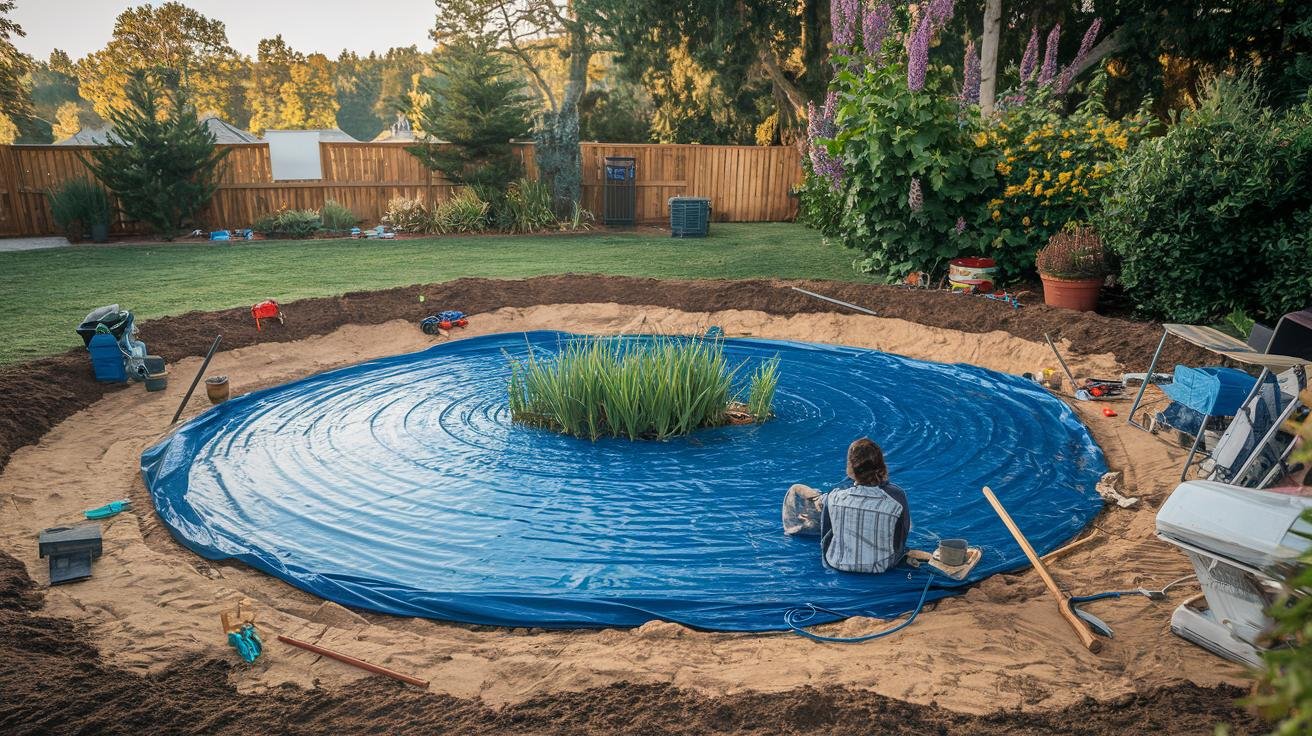
However you shape it, dig 18 to 24 inches deep with gently sloped sides. The slope matters more than people expect — it lets frogs, birds, and the occasional curious chipmunk climb in and out instead of getting stuck, and it keeps the liner from bunching. Lay a layer of underlayment fabric across the excavation first to protect the liner from roots and sharp stones, then roll the liner out slowly and work the air pockets toward the edges. Tuck flat stones around the rim to pin everything down. If you’re planting directly into shelves, cut small X-slits in the underlayment so roots can reach the soil beneath.
Pumps, Waterfalls, and Keeping the Water Moving
Still water is where ponds go wrong. Moving water stays clearer, holds more oxygen, and simply sounds better, which is half the reason you’re building the thing. A fountain gives you a gentle vertical spray; a waterfall tumbles water over a ledge and adds aeration as it falls. For a container pond or a small decorative urn, a solar fountain pump is the tidy, no-wiring answer — something like the AISITIN solar fountain pump ($) runs off a small panel and needs no outlet at all. For anything with real volume or a waterfall to feed, step up to a corded circulation pump like the TetraPond Water Garden Pump ($$), sized so it turns over the whole pond’s volume roughly once an hour.
Clarity is the other half of the equation. Bubblers and diffusers push oxygen down where fish and the good bacteria live, and a UV clarifier zaps the free-floating algae that turns water green before it gets a foothold. Dropping in a filter-and-clarifier unit like the TotalPond filter with UV clarifier ($$) does the mechanical filtering and the algae control in one housing, which is the setup I’d recommend for any pond holding fish. Even a small bubbler tucked under the lily pads eliminates the dead spots where algae spores like to settle — no harsh chemicals required.
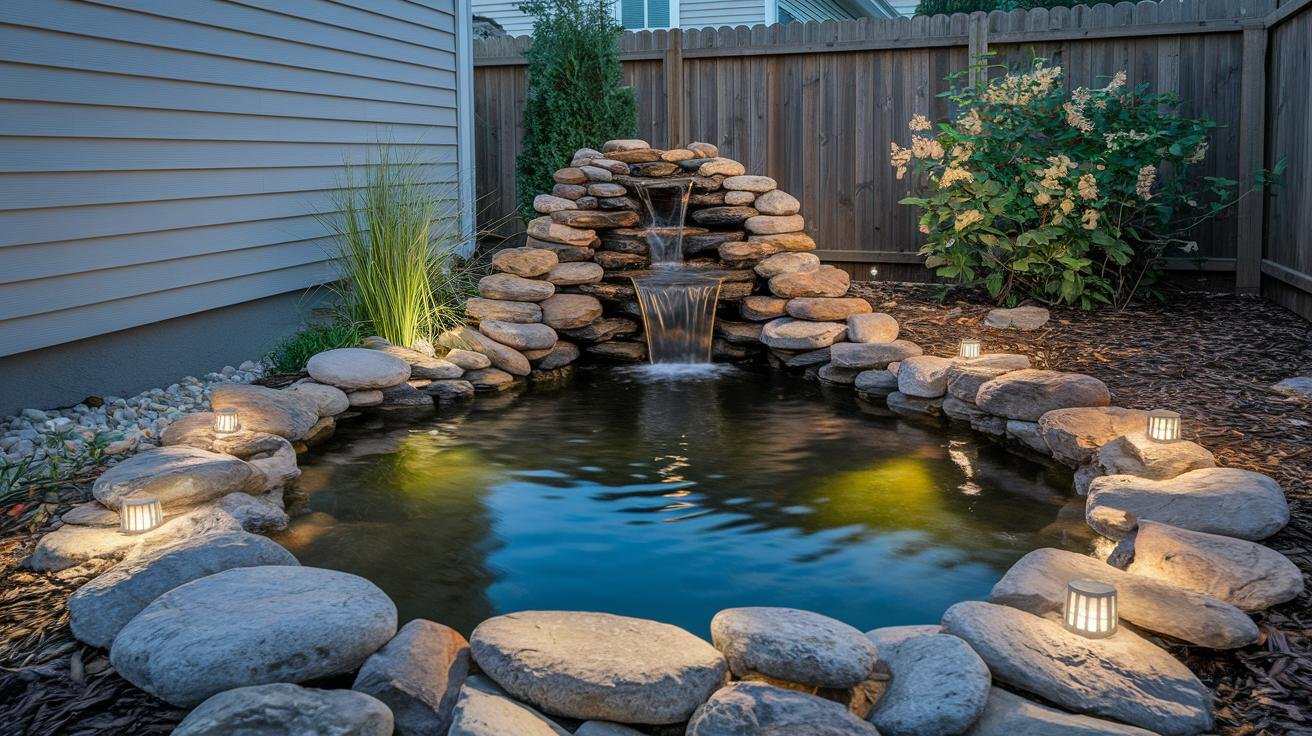
Building a rock waterfall is genuinely satisfying, like sculpting a little stream into the yard. Hide the hoses and pipe behind stone so the water appears to spill from the rock itself, and stack flat flagstones at slightly different angles to vary the flow and the sound. Tuck the pump and filter into a covered chamber near the edge, and slip the intake under a large river rock so the hardware disappears. The goal is water that looks like it’s always been there.
Plants and Fish That Do the Work
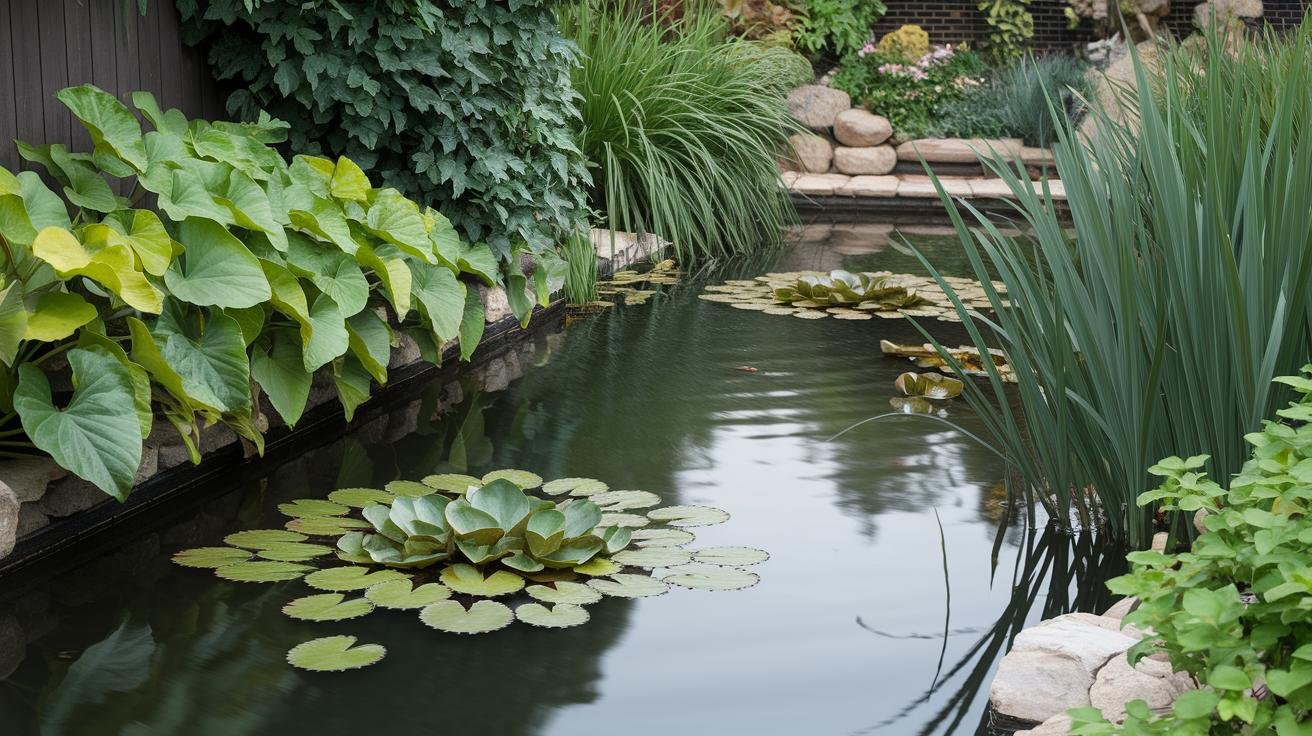
The right plants aren’t just decoration — they’re free filtration. Marginal plants like marsh marigold sit at the pond’s edge with their roots in the muck, pulling up nutrients and trapping debris before it clouds the water. Floating plants such as water lettuce and lotus shade the surface, which cools the water and starves algae of the light it needs. And submerged oxygenators like elodea or hornwort work below the surface, adding oxygen and keeping things clear. Use a mix of all three and you’ve built a small ecosystem that mostly runs itself; the frogs and damselflies usually show up within a season.
Water lilies are the showpiece, with pads that float like dinner plates and blooms that open with the morning sun. Choose hardy lilies in cooler regions and tropical types where summers run long. Plant the rhizomes in wide, shallow pots of heavy clay soil and sink them 12 to 18 inches below the surface, then wait for the first buds. When the leaves yellow in late fall, trim them back and move potted tropicals somewhere frost-free until spring.
Fish need a little planning. Aim for at least 18 inches of depth and figure roughly two cubic feet of water per fish so nobody’s crowded. Koi are the classic choice, but they grow large and demand deeper zones, a sloped feeding shelf, and some protection from herons — a net, or a decoy the birds learn to distrust. Goldfish are the easier starter: hardy, cheap, and forgiving, though they still want clean, oxygen-rich water and a modest filter. Ringing the pond with shallow bog shelves, four to six inches deep and planted with iris, marsh mint, or rushes, adds one more layer of natural cleaning — those roots drink up the leftover nutrients that would otherwise feed an algae bloom.
Lighting and Finishing Touches
Lighting is what turns a daytime pond into an evening one. Submerged LED lights make fish scales glow and catch the undersides of the lily pads; solar spotlights staked at the water’s edge charge by day and switch on after dark with no wiring at all; low-voltage fixtures along the rim throw a soft glow while sipping very little power. A few well-placed lights make a nighttime walk to the pond worth taking.
Around the water, natural materials sell the effect. I like to set a couple of boulders and maybe a short wooden bridge for a storybook feel, then add a bench or a flat stone where you can actually sit and listen. A winding paver path through ferns or moss draws you toward the water, and a small stone lantern throws dancing shadows across the surface at night. If you already run a fire feature nearby, a pond pairs beautifully with these backyard fire pit ideas — water and fire in the same view is hard to beat.
One thing I won’t skip is footing. Wet stone is slick, so choose slip-resistant pavers around the edge and line any steps with low lights so nobody misjudges a stride in the dark. Keep solar panels clear of fallen leaves so the lights actually charge. Small precautions, but they’re the difference between a pond that’s a pleasure and one that’s a hazard.
Year-Round Pond Care
A pond’s workload changes with the seasons, and staying ahead of it is easier than catching up. When the frost lifts in spring, skim out the winter’s twigs and leaves, test the water for pH and ammonia so your fish start the year in good conditions, and rinse or replace the filter pads that clogged over winter. Let the fresh water settle before you set floating plants back out.
Summer is algae season, because algae loves heat and light. Barley straw packs and a running UV clarifier keep the water clear the gentle way, and a quick morning skim plus an emptied skimmer basket stops debris from breaking down into fish-fouling sludge. Rinse the pump screen and swap the filter floss on a regular rhythm and the water stays sparkling.
As the leaves start to fall, drape a mesh net over the pond so debris slides off instead of sinking and rotting on the bottom. Keep skimming the stragglers, give the pump a rinse, and check hoses and seals for wear before the cold sets in. Once ice forms, winterizing is mostly about keeping fish alive: run an aerator or a floating de-icer like the K&H Thermo-Pond de-icer ($$) to hold a hole open in the ice so gases can escape and oxygen can get in. Pull any pump that isn’t rated to run in freezing water and store it somewhere warm until spring. Do that, and your fish coast through winter and the whole system wakes back up when the thaw comes.
Recommended Gear for Your Backyard Pond
Here’s the shortlist I’d hand a friend starting their first pond, grouped by what each piece does:
- TotalPond Complete Pond Kit ($$$) — easiest all-in-one start; liner, pump, and fittings matched in one box.
- TetraPond EPDM Pond Liner ($$) — flexible, cold-tolerant liner for a custom shape.
- TetraPond Water Garden Pump ($$) — the workhorse for circulation and feeding a waterfall.
- AISITIN Solar Fountain Pump ($) — budget, no-wiring aeration for container and small ponds.
- TotalPond Filter with UV Clarifier ($$) — filtering and green-water control in one unit.
- K&H Thermo-Pond De-Icer ($$) — keeps a breathing hole open in winter ice for fish.
Backyard Pond FAQ
What backyard pond kits are available?
Pond kits come as rigid preformed shells, flexible-liner-and-pump bundles, and full DIY kits that include underlayment, liner, pump, and fittings — all of which let you skip custom excavation and get water in the ground fast.
What are some budget-friendly backyard pond ideas?
Upcycled whiskey barrels, preformed liners, and container water gardens can all come together for a couple hundred dollars, letting you build a charming feature with simple materials and basic hand tools.
How deep should a backyard pond be?
A simple water garden without fish can be as shallow as 18 inches, but plan on 24 to 36 inches once you’re keeping fish, since the extra depth stabilizes temperature and gives roots and fins room to thrive.
Do you need a permit to build a backyard pond?
Often yes for in-ground ponds past a local size limit — commonly around 100 square feet — or where depth triggers fencing rules. Check with your city or county planning department, and have utility lines marked, before you dig.
Can fish live in a pond without a pump?
Hardy fish like goldfish can survive in a well-planted pond with plenty of oxygenating plants and regular partial water changes, but a gentle aerator or pump keeps the water clearer and the fish healthier with far less effort.
How do I keep pond water from turning green?
Shade part of the surface with floating plants, add submerged oxygenators, run a UV clarifier, and keep the water moving. Together those four steps starve algae of the light and still water it needs to bloom.