How to Plan and Care for Hanging Basket Gardens
A well-planted hanging basket adds color at eye level, frees up ground space, and delivers more visual punch per dollar than almost any other garden purchase. The catch: hanging baskets dry out faster than in-ground beds, drain nutrients quicker, and need more thoughtful plant selection than the average garden bed. Get the basics right and a basket that cost $25 to plant in May looks better in August than most professional landscaping.
This guide covers what makes a good hanging basket, picking plants for your sun exposure, the maintenance rhythm that keeps baskets producing all season, seasonal swaps, basket type and material choices, common problems and fixes, and how to assemble a basket from scratch. For ground-level alternatives that pair with hanging baskets in a small space, see our guide on DIY modular vertical garden panels.
Why Hanging Baskets Are Worth the Effort
Two things make hanging baskets different from any other garden format: they put plants at eye level (where you actually see them while sitting on the patio), and they grow upward into airspace that’s otherwise unused. Both matter for a few specific situations.
Small spaces. A 3×3-foot patio can host four hanging baskets along its perimeter without losing a square foot of usable floor space. Each basket holds 4 to 6 plants — that’s 16 to 24 plants on a patio that couldn’t accommodate a single planter on the ground.
Renter situations. Hanging baskets attach to ceiling beams, deck railings, fence tops, and shepherd’s hooks — no permanent structures, no hole-digging. When you move, the baskets come with you.
Pet and pest protection. Plants suspended overhead avoid dog tramplings, rabbit nibbles, and slug damage that destroys ground-level plantings.
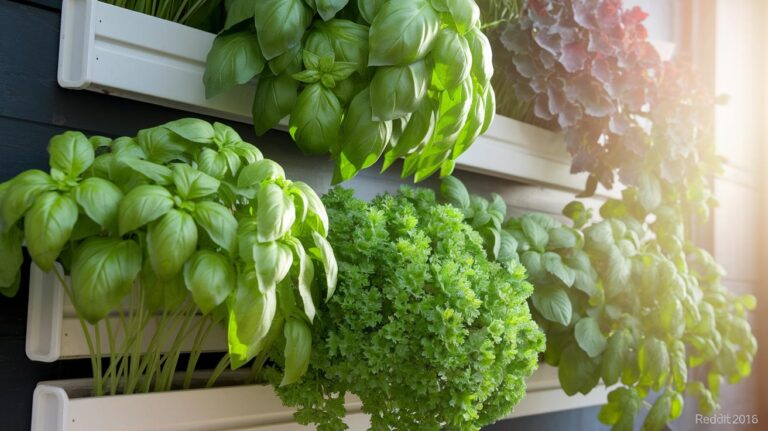
Vertical garden composition. Hanging baskets read as part of an integrated vertical garden when paired with wall-mounted planters and trellised climbing vines. The eye sees a wall of greenery rather than scattered pots.
The trade-off is real: hanging baskets need more frequent watering and feeding than ground beds. Plan on daily watering in summer heat, twice daily in extreme conditions. If you travel often or want a low-maintenance garden, in-ground beds or self-watering containers are easier picks.
Picking Plants by Sun Exposure
Match the plant list to your sun exposure first, then pick aesthetic preferences within that group. The wrong plant in the wrong light fails fast.
Full sun (6+ hours direct sunlight):
- Petunias — classic trailing varieties bloom continuously through summer. Wave-series cultivars are the gold standard for weather resistance and trailing habit.
- Geraniums (Pelargoniums) — reliable, drought-tolerant, and forgiving of inconsistent watering. Several colors and forms available.
- Calibrachoa (Million Bells) — small petunia-like flowers covering the plant. Self-cleaning, no deadheading needed.
- Verbena — clusters of small flowers in jewel tones. Attracts butterflies.
- Lantana — heat-loving and drought-tolerant. Best choice for hot dry climates and inconsistent watering.
- Sweet potato vine (ornamental) — non-blooming trailing foliage in chartreuse, deep purple, or variegated greens. Useful as the “spiller” element in mixed baskets.
Part sun (4-6 hours):
- Begonias (tuberous and dragon wing) — flowering through partial shade conditions. Dragon wing varieties handle more sun and tolerate brief afternoon dryness.
- Coleus — grown for foliage, not flowers. Modern varieties come in vivid color combinations including chartreuse, burgundy, and variegated.
- Fuchsia — pendulous flower structures pair naturally with hanging baskets. Need consistent moisture.
Shade (2-4 hours filtered light):
- Boston fern — classic fountain of green fronds for shaded porches. Needs humidity; mist regularly in dry climates.
- Impatiens — continuous blooms in shade. Bounce-series cultivars resist downy mildew that ravaged older impatiens varieties.
- Lobelia (trailing) — cascading purple, blue, or white flowers in cool weather. Stops blooming in summer heat; revives in cooler fall.
- Ivy — evergreen trailing foliage. Lasts year-round in mild climates.
For shade-specific plant ideas across all vertical garden contexts, see our guide to shade-friendly plants with butterfly appeal.
The thriller-filler-spiller framework
Designers compose mixed-plant baskets around three roles:
- Thriller — one upright dramatic plant in the center. Geranium, salvia, dragon wing begonia, or a tall coleus.
- Filler — bushy plants that fill mid-height around the thriller. Petunias, calibrachoa, lobelia.
- Spiller — trailing plants that cascade over the edge. Sweet potato vine, trailing verbena, bacopa, ivy.
A standard 14-inch basket holds 1 thriller, 2-3 fillers, and 2-3 spillers comfortably. Mixing leaf textures and flower colors within those slots creates the layered look that wins design awards.
The Watering and Feeding Rhythm
Hanging baskets dry out 2-3 times faster than the same plants in ground beds. The suspended airflow on all sides plus the small soil volume conspire against moisture retention.
| Conditions | Watering frequency |
|---|---|
| Cool spring or fall, partial shade | Every 2-3 days |
| Warm summer, partial shade | Daily |
| Hot summer (85°F+), full sun | Daily, sometimes twice daily |
| Windy or exposed locations | Add 50% to the above frequency |
Watering technique:
- Water in the morning so foliage dries before evening. Wet leaves overnight invite fungal disease.
- Water until it drains from the bottom of the basket. A soaked-through basket lasts longer than a topped-up one.
- If water runs straight through without soaking, the root ball has gone hydrophobic. Either submerge the whole basket in a bucket of water for 15 minutes, or water in three small passes spaced 10 minutes apart.
- Install drip irrigation with individual emitters for each basket if you have more than four baskets or travel often. A $40-$80 setup with a timer handles daily watering hands-free.
Feeding rhythm: hanging basket plants exhaust the small soil volume’s nutrients within 4-6 weeks. Use a water-soluble fertilizer with balanced NPK (10-10-10 or similar) at half the package strength, every 1-2 weeks during the growing season. Slow-release granules mixed into the soil at planting handle the first 6 weeks; supplement with water-soluble after.
Seasonal Plant Rotation
One basket can host three or four different plant compositions across the year, extending its visual interest from a single summer to year-round.
Spring (March-May): cold-hardy options that handle late frosts — pansies, violas, snapdragons, primulas. Add trailing sweet peas for fragrance.
Summer (June-August): the workhorse season. Sun-loving combinations of petunias, geraniums, and calibrachoa with trailing sweet potato vine or bacopa.
Fall (September-November): chrysanthemums and ornamental kale as the main features, with trailing ivy for structure that lasts into winter.
Winter (December-February): in mild climates (zones 8+), winter pansies and ornamental cabbage continue blooming through cool weather. In cold climates, swap to evergreen ivy and dwarf conifers, or take baskets down and store dormant perennials in a protected spot.
For each rotation, fresh potting mix mixed 50/50 with the existing soil refreshes nutrients without the cost of a complete soil swap. Slow-release fertilizer goes in with the new plants.
Basket Types and Materials
The basket itself affects watering frequency, durability, and aesthetic. Three common categories:
Wire baskets with coconut fiber (coir) liners. Most traditional look. Good drainage. Pre-formed coir liners last 1-2 seasons; replace as they break down. Hold less water than solid baskets, so daily watering is required in most conditions.
Moss-lined wire baskets. Most attractive of the traditional options. Sphagnum moss liner holds water better than coir but needs more careful initial soaking. Beautiful, but moss-lined baskets dry out fastest of any type.
Plastic-lined wire baskets and self-watering plastic baskets. Most practical. The plastic liner reduces evaporation by 30-50% compared to coir or moss. Self-watering plastic baskets with a reservoir below the soil zone extend the watering interval to 2-3 days even in hot weather.
Eco-friendly alternatives:
- Repurposed wooden boxes — drill drainage holes; add a plastic liner with drainage holes if the wood is untreated to extend its life.
- Recycled plastic containers — yogurt containers, ice cream tubs, even gallon milk jugs cut in half. Drill drainage holes and decorate with rope or jute wrapping.
- Biodegradable coir baskets — fully compostable when they break down (3-5 seasons typically).
Basket size matters more than material. Larger baskets (14-16 inches) hold more soil and retain moisture longer than small (10-12 inch) baskets. For low-maintenance, choose the largest basket your space and hardware can support.
Common Problems and Solutions
Three problems show up in nearly every hanging basket eventually:
Drought stress (wilting between waterings). Symptoms: leaves wilt in afternoon, basket feels light when lifted. Fixes: add water-retaining polymer crystals to the potting mix (sold at garden centers; about $8 for a treatment that lasts a season); switch to a larger basket; add a self-watering reservoir insert; install drip irrigation with a timer.
Wind damage and basket swing. Symptoms: plants blow sideways, stems break, basket swings hard enough to splash water out. Fixes: choose wind-resistant plants (geraniums and lantana over delicate petunias); install brackets that hold the basket closer to a wall or post; add a stabilizing bottom anchor (a hook on the wall below the basket that you loop through a basket-bottom ring).
Uneven growth (one side fuller than the other). Symptoms: basket grows lopsided as the sun-facing side outpaces the shaded side. Fixes: rotate the basket a quarter-turn each week; pinch back over-growing trailing strands to encourage bushiness; ensure all sides get reasonable light by relocating to a more open spot.
Pests in hanging baskets: aphids on petunia stems, whiteflies under leaves, spider mites in dry conditions. Spray off with the hose first; if persistent, treat with insecticidal soap (safe for plants and pollinators).
For broader pollinator-friendly planting that pairs with hanging baskets, see our guide to designing a pollinator garden.
Assembling a Hanging Basket from Scratch
A 14-inch basket takes about 15 minutes to plant once your materials are assembled.
Materials per basket:
- Hanging basket (14-inch wire or plastic, with chain or hanger hardware)
- Coconut fiber liner or moss for wire baskets
- High-quality potting mix (NOT garden topsoil — too dense)
- Slow-release fertilizer granules
- Plants: 1 thriller, 2-3 fillers, 2-3 spillers
- Optional: water-retaining polymer crystals, drip irrigation emitter
Assembly steps:
- Fit the liner. Press a coconut fiber liner into a wire basket so it conforms to the curve. Trim excess at the top edge. For moss, layer about 1 inch of damp sphagnum moss against the wire.
- Add slow-release fertilizer. Sprinkle about 2 tablespoons of granules into the bottom of the liner.
- Fill with potting mix to about 2 inches below the rim. Mix in water-retaining crystals at the package rate if using.
- Plant the thriller first. Place the upright centerpiece in the middle of the basket. Adjust soil level so the root ball sits at the same depth as it was in its nursery pot.
- Add the fillers around the thriller. Tuck each filler plant into a hole pushed into the soil, spacing evenly around the basket.
- Tuck the spillers at the edges. Plant trailing varieties right at the basket rim with their root balls angled slightly outward so the trails fall over the edge naturally.
- Water thoroughly until water drains from the bottom. This first watering settles the soil; you may need to add a bit more mix and re-water.
- Hang and adjust. Mount on a sturdy hook or shepherd’s hook rated for 25+ pounds (a wet 14-inch basket can weigh 20 pounds). Check the basket level and adjust the chain length if it hangs lopsided.
By week 2, the plants will start filling in. By week 6, the basket should look substantially fuller than at planting. By peak season (typically 8-10 weeks after planting), the basket reaches its full potential.
For setup in a tranquil sitting area where hanging baskets become the focal point, our guide on creating a tranquil space in your yard covers seating arrangements and shade integration that work with hanging baskets.
Hanging Basket Gardening FAQ
What is the easiest low-maintenance plant for hanging baskets?
Lantana and geraniums are the easiest sun-loving hanging basket plants — both tolerate inconsistent watering and bloom continuously without deadheading. For shade, ivy and Boston fern require very little once established. Succulents like Burro’s Tail work in dry-climate hanging baskets where overwatering is the bigger risk than under-watering.
What month is best to plant hanging baskets?
Plant hanging baskets in early to mid spring, once your last frost date has passed (typically late April to mid-May in most zones). This timing gives plants 6-8 weeks to establish before peak summer heat. For continuous color, plant winter-hardy varieties in late September or early October for fall and winter displays.
What are the easiest outdoor hanging plants to keep alive?
Petunias, geraniums, lantana, calibrachoa, and Boston fern are the most forgiving. All tolerate occasional missed watering, recover from temporary stress, and don’t require precise feeding schedules. Avoid fuchsias and impatiens unless you can maintain consistent moisture — both fail quickly when they dry out.
What are the disadvantages of hanging baskets?
The main drawbacks are increased watering frequency (sometimes daily or twice daily in heat), more frequent fertilization (every 1-2 weeks vs. monthly for ground beds), and wind exposure that can damage delicate flowers. The small soil volume means roots can’t access deep moisture or nutrients like in-ground plants can.
Where can I find large outdoor hanging planters?
Large and extra-large hanging planters (14-inch and up) are widely available at garden centers, online retailers like Amazon and Wayfair, and home improvement stores like Home Depot and Lowe’s. Quality varies widely — look for thick metal frames, sturdy chain hardware rated for 25+ pounds wet, and durable liners that will last multiple seasons.
How do I prevent hanging baskets from drying out so fast?
Combine three strategies: choose the largest basket your space allows (more soil = more moisture retention), add water-retaining polymer crystals to the potting mix at planting, and install drip irrigation with individual emitters for each basket and a timer that waters daily in summer. Self-watering plastic baskets with built-in reservoirs are the easiest hands-off solution.
How do you fertilize hanging baskets?
Mix slow-release granules into the potting mix at planting (about 2 tablespoons per 14-inch basket). Supplement with water-soluble fertilizer at half strength every 1-2 weeks during the growing season. Balanced NPK formulas like 10-10-10 work for flowering plants; bloom-boosting formulas with higher phosphorus push more flowers but can stress foliage growth.