Bamboo Garden Ideas for Privacy and Pathways
Bamboo is one of the most versatile plants available to a home gardener — and one of the most misunderstood. People hesitate because they’ve heard bamboo spreads and takes over. That concern is legitimate for running varieties, but clumping bamboo is well-behaved and genuinely useful. Whether you want a living privacy screen, a low-maintenance border, a tropical focal point, or material for DIY garden projects, there’s a bamboo that fits the purpose.
This guide covers the key decisions — species selection, placement, edging and pathway use, privacy applications, and maintenance — so you can add bamboo to your garden confidently.
Clumping vs. Running Bamboo and Why It Matters
Before choosing any bamboo variety, you need to understand the fundamental split between clumping and running types. Getting this wrong is the source of most bamboo regret.
Clumping bamboo (genera like Bambusa, Fargesia, and Chusquea) grows outward gradually from a central crown, adding a few inches of diameter per year. It doesn’t spread via underground rhizomes in any aggressive way, which makes it an excellent choice for defined spaces like borders, containers, and accent plantings. It’s the right choice for most residential gardens.
Running bamboo (primarily Phyllostachys) sends out horizontal underground rhizomes that can travel several feet from the parent plant each season. It creates dense, impressive thickets, which makes it useful for screening large areas quickly — but only with a physical root barrier of at least 60-mil high-density polyethylene installed to a depth of at least 24 inches around the planting area. Without containment, running bamboo will colonize neighboring beds, lawns, and even cross property lines.
The practical rule: unless you have a specific large-scale screening need and you’re prepared to install and maintain root barriers, choose a clumping variety. For most backyard applications, you won’t notice the difference in appearance, and you’ll never regret your choice.
Matching bamboo to your climate is equally important. Fargesia species are among the most cold-hardy clumping bamboos, surviving temperatures well below 0°F, making them suitable for Zone 5 and colder. Bambusa varieties are more cold-sensitive and suited to Zone 8 and warmer. Check your USDA hardiness zone before purchasing.
Choosing the Right Bamboo for Your Specific Use
Different bamboo varieties perform very differently in mature height, culm (cane) diameter, leaf density, and light requirements. Narrowing your list based on intended use saves time and money.
For privacy screens: You want height and density. Phyllostachys nigra (black bamboo) is popular for its striking dark culms and reaches 20–25 feet in warm climates, though it’s a runner. Among clumping options, Bambusa oldhamii reaches 20–55 feet in frost-free climates. For colder zones, Fargesia robusta ‘Campbell’ grows to 12–15 feet and holds its leaves through winter, creating a year-round screen.
For containers and small gardens: Dwarf clumping varieties like Bambusa multiplex ‘Tiny Fern’ or Fargesia nitida stay compact and manageable. Container growing is also an effective way to use running bamboo in a small space — the container acts as a natural root barrier.
For accent plantings: Black bamboo (Phyllostachys nigra) adds strong visual drama with its dark culms. Even a single clump in a gravel garden or against a light-colored wall reads as a designed feature.
For light and soil: Most bamboos prefer six or more hours of sunlight per day, though Fargesia species tolerate and even prefer partial shade. All bamboos grow best in well-draining, slightly acidic soil. They struggle in waterlogged conditions, which causes root rot and yellowing leaves.
Using Bamboo for Garden Privacy Screens
Privacy is the most common reason homeowners add bamboo, and it’s genuinely effective for this purpose. A well-placed bamboo screen can block a neighbor’s sightlines, muffle street noise, or create a backdrop that makes the rest of the garden feel like a contained outdoor room.
For a privacy hedge, plant clumping bamboo in a single row, spacing each plant according to the variety’s mature width. Most clumping species should be spaced three to six feet apart. The hedge will appear sparse in the first two years and fill in significantly by year three. If you want faster establishment, plant more densely and thin later.
Position the screen on the north or east side of a seating area if possible, so the bamboo doesn’t shade a garden bed or vegetable plot that needs full sun. If you want the bamboo screen to also serve as a backdrop to ornamental planting, choosing the right fence-line plants matters — our guide to backyard fence line gardening covers how to layer plants against a boundary effectively.
Bamboo Edging and Pathway Ideas
Bamboo is an excellent material for edging garden beds and defining pathways. It has a natural texture that complements both rustic and contemporary garden styles, and it weathers to an attractive silver-grey over time when left untreated.
Three practical bamboo edging approaches:
Split bamboo roll edging is the easiest to install. Rolls of split bamboo canes are available at garden centers and online and can be staked along the edge of a bed with landscape pins or cut bamboo stakes. They create a clean, low border with a naturalistic look. Expect to replace them every three to five years as weathering occurs.
Bamboo stake borders use upright canes of varying heights installed in a line along a pathway. This approach works well in a Japanese or contemporary Asian-influenced garden. Drive the canes six to eight inches into the soil for stability, and use a rubber mallet rather than hammering directly on the culm to avoid splitting.
Interwoven bamboo panel edging is more labor-intensive but creates a decorative woven pattern along curved pathways. Thin, flexible bamboo strips are woven between upright stakes to follow any curve. This looks particularly effective in cottage-style gardens where the organic irregularity feels appropriate.
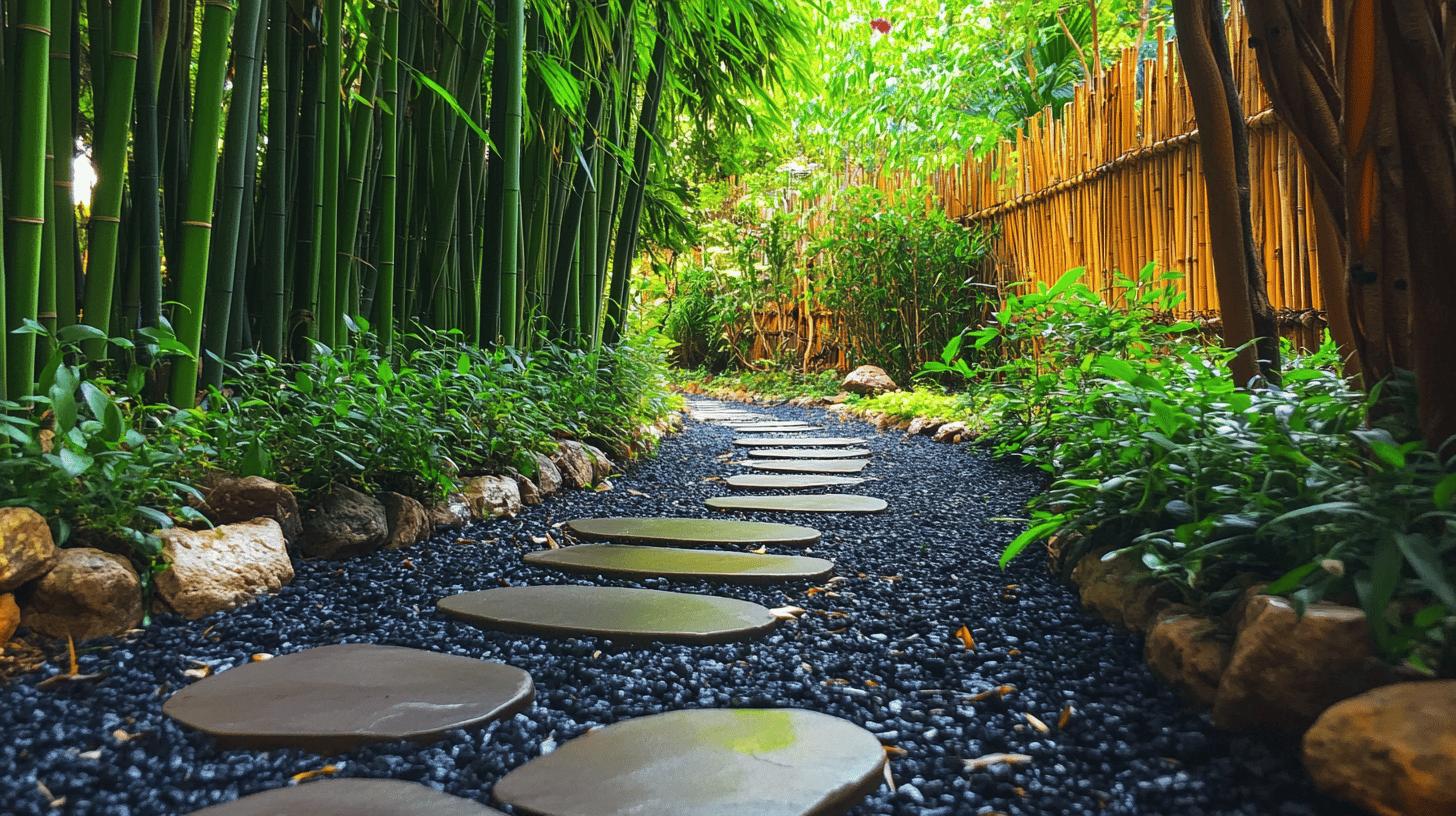
For pathways themselves, bamboo can be incorporated through stepping-stone borders or as overhead arching canopy when tall bamboo is planted on both sides of a narrow path. The effect in a small space can feel like a completely different environment — which makes bamboo one of the more effective plants for creating a tranquil space in your yard.
DIY Bamboo Projects for the Garden
Bamboo’s physical properties — hollow, lightweight, strong, and easy to cut — make it ideal for DIY garden projects. Many of these use harvested culms from mature clumps in your own garden, which adds sustainability to the appeal.
Bamboo trellises are simple to build using bamboo poles lashed together with jute twine. A basic A-frame or teepee structure takes less than an hour and provides support for climbing beans, cucumbers, or ornamental vines like Thunbergia.
Container stands and plant display risers can be built by bundling cut bamboo sections into legs and topping them with a wood or tile surface. The natural texture pairs well with terracotta pots and hanging baskets.
Water features are a more ambitious but rewarding project. A bamboo spout drilled to accept tubing and run over a basin of rocks creates the classic Japanese shishi-odoshi (deer-scarer) sound feature. Kits are available, or the spout can be made from a single large-diameter culm.
Wind chimes and garden art can be made from off-cuts of different lengths. Bamboo chimes have a warmer, more resonant tone than metal equivalents.
Pairing Bamboo with Companion Plants
Bamboo by itself can read as monolithic, especially in a small garden. Pairing it with the right companion plants softens the planting, fills the gap at ground level, and creates visual rhythm.
Low groundcovers work well at the base of taller bamboo. Creeping thyme, sweet woodruff, and Japanese forest grass (Hakonechloa macra) all tolerate the dappled shade beneath a mature bamboo clump. They cover the bare soil and stop weeds without competing with the bamboo for nutrients.
Mid-height perennials can be tucked between bamboo clumps to bridge the visual gap. Hostas, astilbes, and ferns thrive in the part-shade conditions that mature bamboo creates and contrast attractively with bamboo’s vertical lines.
Stone and gravel instead of plants is the traditional Japanese pairing. A gravel apron around a bamboo clump, with a few well-placed stepping stones or a single ornamental boulder, lets the bamboo be the star. This works especially well in a contemporary or zen-inspired design.
Container companions. If the bamboo is in a container, pair it with trailing plants like sweet potato vine or creeping Jenny that spill over the edge of the pot. The horizontal trailing softens the strong vertical lines of the bamboo.
Avoid plants that compete aggressively for water. Established bamboo is thirsty; don’t plant moisture-loving perennials like astilbes too close to the clump or both will suffer. Maintain a 12-inch ring of mulch or groundcover around the bamboo base to reduce direct competition.
Maintaining Your Bamboo Garden
Bamboo isn’t maintenance-free, but its maintenance requirements are straightforward once you understand what the plant needs.
Watering: Newly planted bamboo needs consistent watering for the first two growing seasons to establish its root system. Once established, most bamboo tolerates dry conditions better than many other plants, though it performs best with consistent moisture. During drought, yellow leaves signal that irrigation frequency should increase.
Fertilizing: Bamboo benefits from a nitrogen-rich fertilizer applied in spring and again in midsummer. Lawn fertilizer is sometimes used for large plantings. Avoid fertilizing after late summer, since this encourages tender new growth that’s vulnerable to frost.
Controlling spread: Even clumping bamboo benefits from a periodic check of its perimeter. If new shoots emerge where you don’t want them, remove them while they’re still soft and easily pulled — far easier than cutting established culms. For running bamboo with root barriers, inspect the barrier edge annually for escaping rhizomes and cut them back to the barrier line.
Removing old culms: Bamboo culms reach their maximum height in one growing season and then mature over the following two to three years. Culms older than five or six years begin to look weathered and discolored. Thinning out the oldest culms each spring keeps the planting looking fresh and lets more light into the center, which encourages healthy new growth.
If bamboo is part of a larger design that incorporates hanging plants, see our guide to backyard gardening with hanging baskets for companion planting ideas that complement bamboo’s vertical lines.
Troubleshooting Common Bamboo Problems
Even well-chosen bamboo runs into the occasional issue. Most of the common problems are easy to diagnose and fix once you know what you’re looking at.
Yellow leaves. The most frequent complaint. Three usual causes: drought stress (most common in newly planted bamboo), nitrogen deficiency, or poor drainage. Check the soil moisture first; if it’s bone dry, water deeply once a week. If the soil is consistently wet, you may need to amend with gravel to improve drainage. If neither, apply a nitrogen-rich fertilizer in spring and again in midsummer.
Sparse or thin growth. Usually a sign of insufficient sunlight, or a clump that’s been in the same spot for more than ten years and is starting to decline. Most bamboo wants at least six hours of direct sun. If light isn’t the issue, divide the clump — dig up the outer sections and replant them, leaving the original center to recover with more breathing room.
Black or grey spots on culms. Cosmetic in most cases, often from fungal spots that don’t affect plant health. If the spots are spreading rapidly or you notice culms collapsing, cut affected canes at the base and dispose of them away from the planting area. Improve air circulation by thinning the clump.
Shoots emerging where they shouldn’t. For clumping bamboo, this means the clump is expanding into unwanted territory. Cut the new shoots off at ground level with a sharp spade while they’re still soft. For running bamboo, this means a rhizome has escaped containment. Trace it back, cut it off at the barrier, and check the barrier itself for damage.
Whole culm dying back. If a single culm browns and dies while others stay healthy, it’s likely just at end-of-life (most bamboo culms live 7 to 10 years). Cut it at the base and let new shoots replace it. If multiple culms die together, look for root rot — pull a culm or check the base for soft, blackened tissue. Improve drainage if rot is present.
The single best preventive measure for almost all bamboo problems is good airflow. A clump thinned to remove its oldest 20% of culms each spring is healthier, more attractive, and more disease-resistant than a dense, unmanaged one.
Bamboo Garden FAQ
How do you start a bamboo garden?
Choose a location with at least six hours of sunlight per day (or part shade for Fargesia varieties) and well-draining soil. Select a clumping variety suited to your climate zone. Dig a hole twice as wide as the root ball and the same depth. Backfill with native soil amended with compost. Water thoroughly and mulch around the base. For best establishment, plant in spring once frost risk has passed.
Is bamboo good for a garden?
Bamboo is excellent for gardens when the right variety is chosen for the purpose. It provides fast-growing screening, attractive structure year-round, low-maintenance coverage once established, and material for DIY projects. The caveat: running bamboo requires root barriers to prevent invasive spread. Choose a clumping variety and bamboo becomes one of the easier structural plants to manage.
How do you maintain a bamboo garden?
Water consistently during the first two years of establishment. Fertilize with a nitrogen-rich product in spring and midsummer. Remove old or discolored culms in spring to encourage fresh growth. For running bamboo, inspect root barriers annually and sever any escaping rhizomes. Monitor for spread at the planting perimeter and remove unwanted shoots while they are still small and easily pulled.
What types of bamboo are best for landscaping?
For most landscaping uses, clumping varieties are preferred because they’re non-invasive. Fargesia robusta and Fargesia nitida work in cold climates; Bambusa multiplex and Bambusa oldhamii work in warm climates. For dramatic ornamental effect, Phyllostachys nigra (black bamboo) is popular despite being a runner, because its dark culms are unusually attractive — use it in a container or with root barriers.
How do you use bamboo for garden privacy?
Plant a row of tall clumping bamboo at three to six foot spacing along the boundary you want to screen. Species like Bambusa oldhamii or Phyllostachys bissetii (with barriers) can reach 15–20 feet and create year-round privacy within three to five years of planting. For faster initial screening, plant more densely and thin later once the hedge fills in.
What is the difference between clumping and running bamboo?
Clumping bamboo grows outward slowly from a central crown and is non-invasive. Running bamboo spreads via underground rhizomes that can travel several feet per season and can become invasive without containment measures. For most residential gardens, clumping bamboo is the practical and responsible choice.
Can bamboo be grown in a small backyard?
Yes. In small backyards, grow bamboo in large containers (minimum 20-gallon for most varieties) to contain it naturally. Dwarf clumping varieties stay under four feet and work as understory plants or in mixed borders. Even in tight spaces, a single container of bamboo adds a structural element that most other plants cannot replicate.