Garden Scavenger Hunt Ideas for Kids of All Ages
A backyard scavenger hunt turns the same patch of yard kids walk through every day into a place worth exploring. Following a list of natural items to find — a smooth stone, a striped leaf, something that smells like mint, a ladybug — trains observation, sparks questions about what plants and bugs are doing, and burns the kind of restless energy that screens make worse.
This guide covers everything you need to set one up: theme ideas for different ages and interests, how to build your own clue cards and checklists, age-appropriate adaptations, educational and STEM variations, and the safety and reward details that keep the experience working.
Why Scavenger Hunts Work for Kids
The activity hits several developmental notes at once. Kids practice categorization (what’s a seed pod vs. an acorn?), language (describing what they find), spatial reasoning (mapping where things are in the yard), and persistence (the hunt isn’t done until the list is complete). They also get sunlight, fresh air, and movement — all things research consistently links to attention and mood improvements in children.
The mechanics are simple. Pick a theme, write or print clue cards, hand each child a small bag or basket for collected items, set boundaries for where they can roam, and turn them loose. Hunts last 15 to 45 minutes depending on the complexity of the list and the kids’ ages.
Three quick safety checks before you start:
- Walk the yard and clear sharp sticks, hose nozzles, and forgotten tools.
- Identify any thorny plants (rose, raspberry, hawthorn) or stinging plants (nettle) and mark them as off-limits.
- Set a clear boundary — the back fence, the patio edge, wherever — so kids know where the hunt ends.
That’s the whole framework. The rest of this guide is variations on it.
Theme Ideas by Type and Interest
A theme gives the hunt focus and stops kids from wandering aimlessly. Six themes that consistently work:
Nature treasures. Find natural objects across categories — a smooth stone, a fallen feather, a Y-shaped twig, a seed pod, something that fits in your hand. The most flexible theme; works for every age.
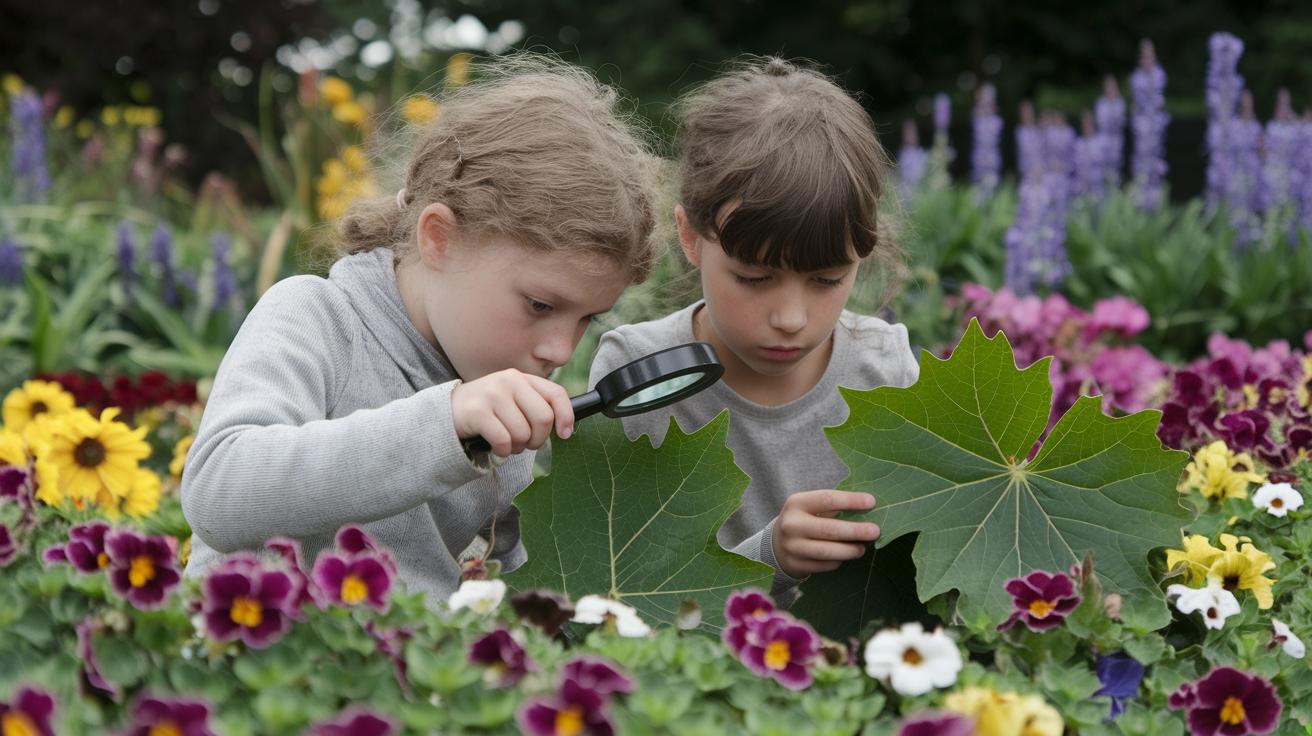
Bug hunt. Find specific insects by lifting leaves, peeking under rocks, and watching flowers. Ladybugs, ants, caterpillars, bees on blooms, spiders in webs. Bring a magnifying glass if you have one.
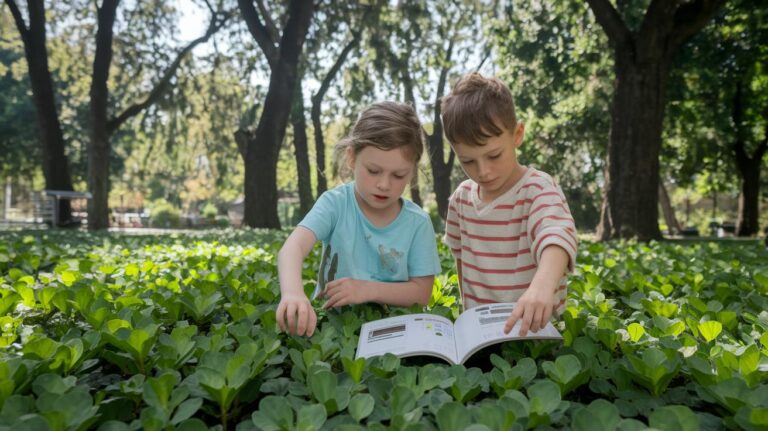
Flower identification. Match printed photos or color cards to real blooms in the yard. Kids notice petal shapes, leaf arrangements, and how scents vary by species. Pairs well with a small plant book.
Leaf collection. Find leaves shaped like ovals, hearts, stars, fans, and serrated edges. Back inside, compare vein patterns and try leaf-rubbings with crayons and paper.
Rainbow hunt. Find one natural item in each color of the rainbow — red petals, orange marigold, yellow dandelion, green grass blade, blue chicory flower, purple violet, brown bark. Surprisingly challenging in a way kids find satisfying.
Sensory exploration. Five sense-based prompts: something rough (bark), something that smells (mint, lavender, basil), something that makes a sound (rustling leaves, crunchy gravel), something soft (moss), something that catches your eye (a sun-lit petal). Especially good for younger kids and for kids who get overwhelmed by complex lists.
Mix and match. A 20-item Nature Treasures + Bug Hunt combo for a 9-year-old who wants a challenge. A 6-item Sensory Exploration for a 4-year-old who needs the wins.
DIY Printable Checklists and Clue Cards
You don’t need to download anything to run a great hunt. A piece of paper, some crayons, and 10 minutes of prep produce a checklist as good as any commercial product. Here’s how to make your own.
Simple checklist (5-10 items, ages 4-8):
- Fold a sheet of paper in half lengthwise.
- Draw a column of 5 to 10 small boxes down the left side.
- Next to each box, draw or write the item to find (a smooth stone, a yellow flower, a ladybug). Pictures work better than words for pre-readers.
- Leave a small “I found it!” space next to each item where the child can mark a check, an X, or a smiley face.
- Slip the list into a plastic page protector or zip-top bag so it survives dew, dirt, and grass stains.
Clue cards with riddles (ages 7-11):
Instead of a list, hand kids a stack of cards each with a riddle clue. They solve the clue, find the item, and bring the card back for the next one.
- “I’m small and round and might be smooth or rough — pick me up.” (a stone)
- “I fell off a tree but I’m not a leaf — find one shaped like a teardrop.” (a seed pod)
- “I have black spots and red wings — find me on a flower.” (a ladybug)
- “I smell like the herb in your spaghetti sauce — find a leaf and rub it gently.” (basil or oregano)
Punch a hole in each card, thread on a ribbon or yarn, and let kids wear the stack around their necks like a detective’s badge.
Tools that improve any hunt:
- Cardstock (heavier paper holds up better than printer paper)
- A laminator or plastic page protectors for waterproofing
- Crayons or chunky pencils (sharp pencils are a hazard for younger kids running around)
- A clipboard so kids have a hard surface to write against
- Small bags or baskets for collected items — paper lunch bags work great
For a printable template you can hand-customize at home, sketch a 3×3 grid on a sheet of paper with one item per box and copy it as many times as you need kids. Each child gets their own customized list in 5 minutes.
Adapting Hunts by Age
Hunts that work for a 4-year-old are too easy for a 10-year-old and vice versa. Match the format to the age group.
| Age group | List length | Clue style | Supervision |
|---|---|---|---|
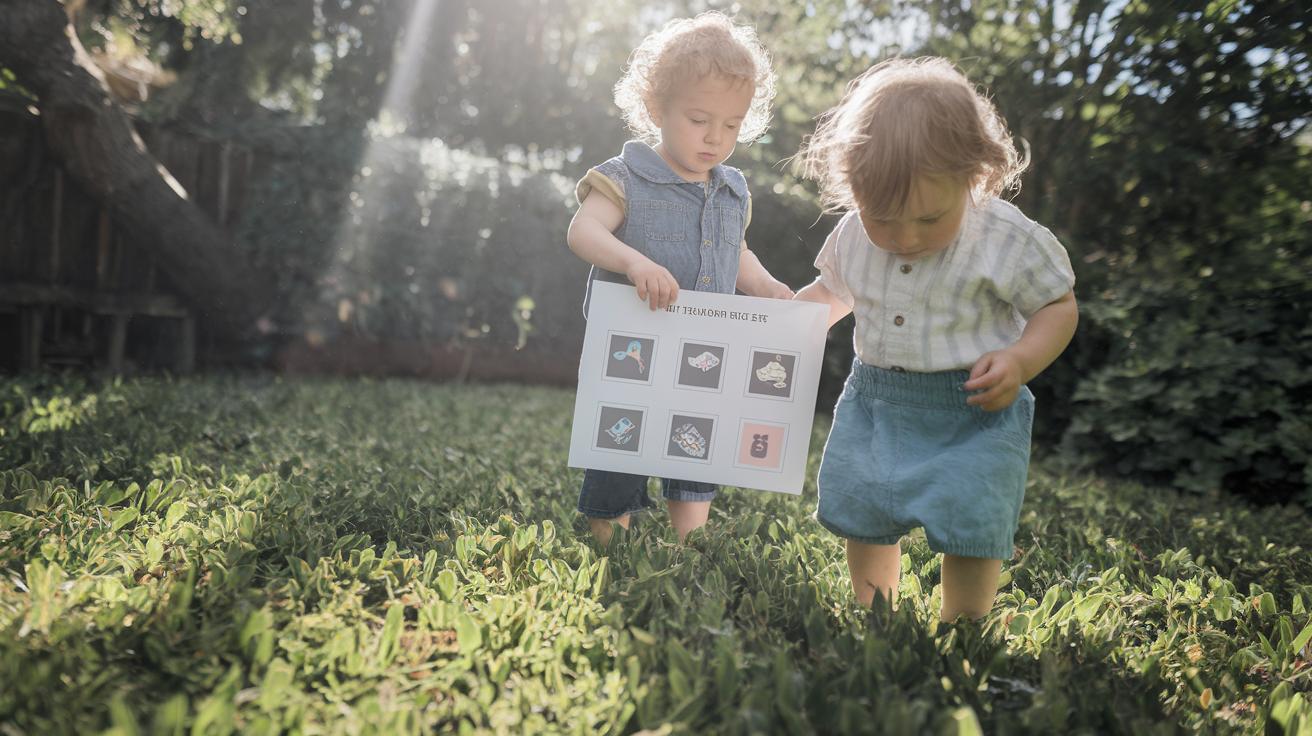
| Toddlers (2-4) | 3-5 items | Picture prompts only; large bright images | Adult walks with the child; hold hands near plants |
| Preschool (4-6) | 5-7 items | Pictures with one-word labels; simple rhymes | Adult in the yard; check on every few minutes |
| Early elementary (6-9) | 8-12 items | Word lists, short clues, or matching cards | Adult supervising from a distance |
| Older elementary (9-12) | 12-20 items | Riddles, puzzles, multi-step clues | Minimal — set boundaries and let them work |
For mixed-age groups, run parallel lists. Younger kids get a simpler list with bigger pictures; older kids get a longer riddle-based list covering the same area. Both finish in about the same time and nobody feels left out or held back.
One more layer: kids on the autism spectrum or with sensory sensitivities often do better with visual lists, predictable structure, and clear “this is what we’re doing for the next 30 minutes” framing. Skip the timed-race elements and lean into the calm exploration version.
Educational and STEM Hunt Variations
Layered onto a basic scavenger hunt structure, science, math, and literacy challenges turn the activity into something that lines up with what kids are working on in school.
Science hunts (curriculum-aligned)
Weather observation hunt. Find and record cloud shapes (a cumulus puff, a wispy cirrus, a flat stratus), wind direction (which way is the flag blowing?), the temperature in shade vs. sun, and what time the next rain falls. Younger kids draw pictures; older kids fill in a simple data table.
Soil sampling. Scoop small handfuls of soil from three different spots in the yard. Rub each between fingers — gritty (sandy), smooth and sticky (clay), or crumbly (loam)? Test pH with a $5 strip from a garden center. Kids learn what “good garden soil” actually means.
Water testing. At a puddle, birdbath, or fountain, observe water clarity, measure temperature with a thermometer, and discuss why shaded water is cooler than sun-exposed water. For older kids, add pH strips designed for water.
Rock identification. Compare rocks by color, shape, grain size, and weight. A simple printable rock-ID chart (look up “rock identification chart for kids” — many free ones exist) lets kids name common types: granite, sandstone, quartz, limestone.
Microhabitat survey. Pair kids up, give each pair a magnifying glass, and have them peek under one log, behind one rock, and around the base of one tree. List the tiny critters they find and sketch each spot’s habitat on graph paper.
Math and engineering challenges
- Estimation: “How many twigs do you think fit end-to-end across the lawn?” Then measure and compare.
- Geometry: Find natural objects shaped like triangles, circles, hexagons (honeycomb!), and spirals (snail shells, fern fiddleheads).
- Fractions: Break a twig in half, then in half again. Discuss halves, quarters, and eighths with the real pieces.
- Measurement: Hand out rulers or tape measures. Find the longest leaf, the widest stone, the tallest blade of grass. Record in inches or centimeters.
- Sorting and counting: Collect 20 small items (acorns, pebbles, seed pods) and sort them by size, color, or shape into groups.
Literacy variations
- Alphabet hunt: Find one natural item that starts with each letter of the alphabet (or as many letters as the child’s age in years). A is for apple blossom, B is for butterfly, C is for clover.
- Story clue cards: Write short riddles in story form — “I buzz around flowers all day and make sweet treats for humans. Who am I?” Reading comprehension disguised as a game.
- Nature journaling: Hand each child a small notebook. After the hunt, they sketch three favorite finds and write one sentence about each — what it felt like, what color it was, where they found it.
For more outdoor activity ideas that pair with scavenger hunts on a family game day, see our guide to backyard games for kids. To build out the yard itself so it has more interesting things to find, our walkthrough on family-friendly backyard design covers planting layouts and feature ideas. And for hunts that include water and pollinator stops, the pollinator garden design guide shows what plants attract bees and butterflies kids can spot during a bug hunt.
Setup, Safety, and Reward Ideas
The setup phase takes 10 minutes and pays back the whole hunt in smoother execution.
Yard prep:
- Walk the perimeter once and clear sharp sticks, hose nozzles, and tools.
- Identify any thorny or stinging plants and mark them with bright tape so kids know to avoid them.
- Note allergy concerns — lilac and goldenrod season can flatten pollen-sensitive kids; reschedule or move the hunt to a different spot.
- Place a small first-aid kit, hand wipes, and a water pitcher in a shaded spot near the hunt area.
- Set the boundary verbally and physically — point at landmarks (“don’t go past the apple tree” / “don’t cross the path”). Younger kids do better with a visible line like a chalk mark or a ribbon.
Accessibility notes:
- For kids using wheelchairs or strollers, choose a route with firm ground and wide pathways. Bend low branches so seated children can reach leaves without standing.
- For kids who get overwhelmed, set up a quiet “base camp” with cushions where they can take breaks and still watch the hunt from a distance.
Rewards that work without sugar overload:
- Printed certificates — a half-sheet template with “Backyard Naturalist” or “Junior Scientist” and the child’s name. Free templates exist online or sketch your own.
- DIY nature badges — press a small flower or leaf between two strips of clear tape on a cardstock circle, punch a hole, tie on a string. Kids wear them home like medals.
- Tiny prizes — magnifying glass, seed packet they can plant at home, kid-sized garden gloves.
- Snack picnic — berries, cheese cubes, lemonade or water in a shaded spot. The shared snack debrief turns into the part everyone remembers.
Extension activities for after the hunt:
- Memory game: Lay all the found treasures on a blanket. Cover them with a towel. Pull off the towel for 30 seconds, then cover again. Kids name as many items as they can remember.
- Nature journaling: Sketch three favorite finds and write one sentence about each.
- Seed planting: Plant any seeds collected during the hunt (acorns, sunflower seeds, dried fruit pits) in small cups of soil to take home. Watching their hunt-find grow into a sprout extends the activity for weeks.
For seasonal variations through the year — spring blossom hunts, summer stone-warming experiments, fall leaf collections, winter frost patterns and bird footprints — adapt the theme ideas above to what’s actually happening in the yard each month. The same checklist structure works year-round; only the items change.
Set up one scavenger hunt this weekend and you’ll have a template you can run any afternoon for years. Each one takes 15 minutes to plan and an hour to execute, and the kids will ask to do it again before you’ve finished cleaning up.