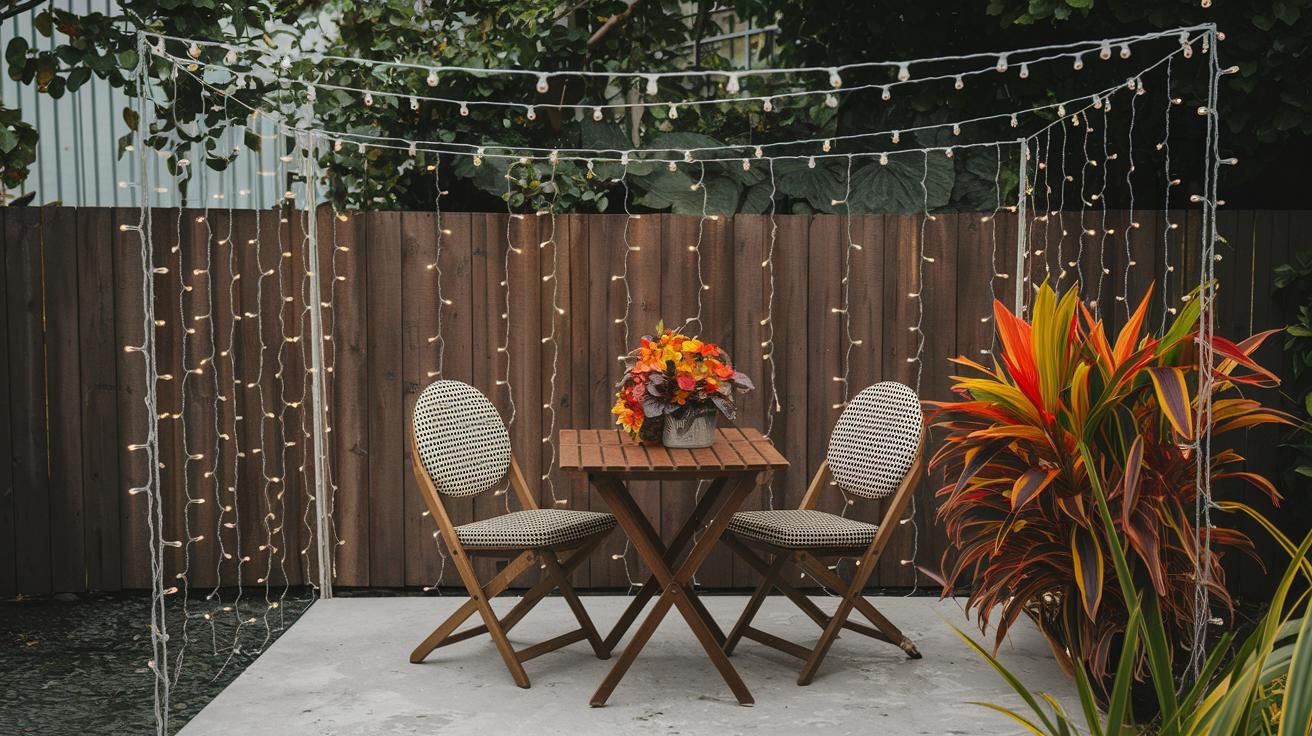
Patio Layout Ideas for Small or Awkward Yards
A patio works when its layout matches how you actually use the space — not when it’s furnished from a catalog. This guide focuses on the practical side of patio layout: how to measure what you have, how to arrange zones around real daily use, what to do with small or awkward footprints, and the visual tricks that make any patio read more spacious. Cross-references to existing posts on outdoor living planning, paver patterns, and furniture choice cover the deeper dives.
Start by Measuring What You Have
Most layout mistakes come from skipping measurement. A patio that looks like it should fit a 6-person dining set often turns out to be 12 inches too short on one side once chairs pull out, or shaped so awkwardly that the table only fits diagonally.
Take five measurements before sketching anything:
- Overall length and width at every edge — patios are rarely perfectly rectangular.
- Distance from any door to the nearest furniture spot. You need at least 36 inches of clear walkway from any threshold.
- Height of walls, railings, or fences on each side. Walls under 4 feet won’t block sightlines; walls over 6 feet may make the space feel boxed in.
- Sun direction across the day — note where mid-afternoon shade falls, and which spots get direct hot sun.
- Fixed obstacles: AC units, downspouts, hose bibs, electrical outlets, gas lines, tree roots. Each of these constrains where furniture can go.
Sketch the result on graph paper at 1 inch = 1 foot. Mark north, mark the door, mark each obstacle. This sketch is the working document for every layout decision that follows.
For the deeper “design my whole outdoor space from scratch” process, the outdoor living area planning guide walks through zone-by-zone design across an entire yard.
Layout Tactics for Small or Awkward Footprints
Patios under 150 square feet, L-shaped patios, or patios with one short dimension that forces a long narrow layout all need different tactics than a square 400-square-foot footprint.
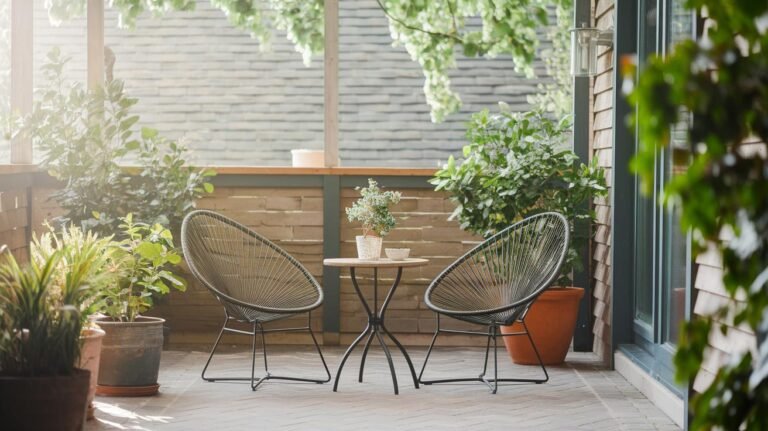
Patios under 150 square feet. Skip full dining sets — they eat the entire footprint. A bistro table for two plus a pair of lounge chairs around a small coffee table covers most use cases. Use stackable or folding pieces so the patio can shift between uses. Wall-mounted folding tables that drop down for dining and fold up for floor space when not in use buy back square footage.
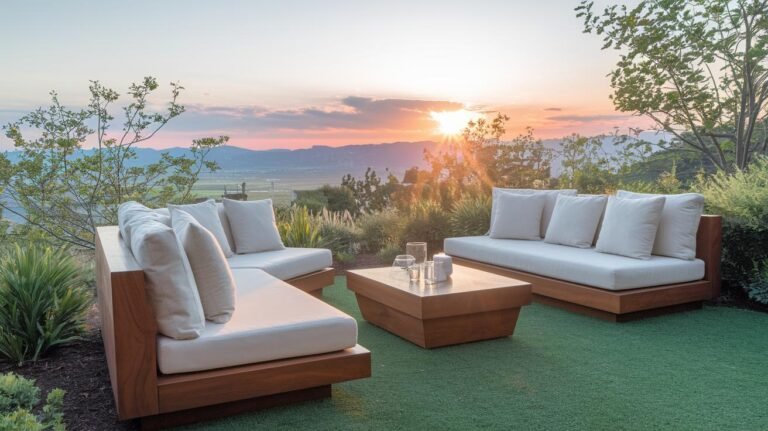
L-shaped patios. Treat each leg as a separate zone. The longer leg usually handles dining; the shorter leg becomes the lounge zone. A corner sectional that runs along the inside of the L makes the corner read intentional rather than wasted. Keep walking space between zones — 36 inches minimum along the inside of the L.
Long narrow patios (under 8 feet wide). One-row furniture only. Bench seating along the wall + a narrow dining table or coffee table out from the bench. Skip anything that requires people to sit on two opposing sides of a single piece. A swing or hammock chair at one end gives the narrow space a focal point.
Patios with awkward angles or curved edges. Don’t fight the shape — work with it. A curved sofa or sectional follows curved edges. A circular dining table fits in spaces where a rectangular one would point a corner into walkway space.
For furniture picks specifically scaled for tight footprints, the small-space lounge chair guide covers compact options across material classes.
Zone Your Patio Around Daily Use
The single most useful layout decision is identifying which zones your patio actually needs and which ones it doesn’t. A patio that tries to do everything usually does nothing well.
Five common zones:
- Lounge. Couch or chair grouping facing each other or a view. Daily-use zone for most households.
- Dining. Table and chairs for meals. High-frequency zone if you regularly eat outside; skip entirely if you don’t.
- Fire. Pit, fireplace, or table. Strong evening anchor; eats square footage with no daytime use.
- Cooking. Grill or full outdoor kitchen. Belongs near the house door for trips back and forth.
- Quiet corner. Reading chair, hammock, or small bistro for morning coffee. Doesn’t need much square footage.
Pick two or three zones that match your actual use, and skip the rest. A 200-square-foot patio with two well-designed zones beats a 200-square-foot patio with five cramped ones.
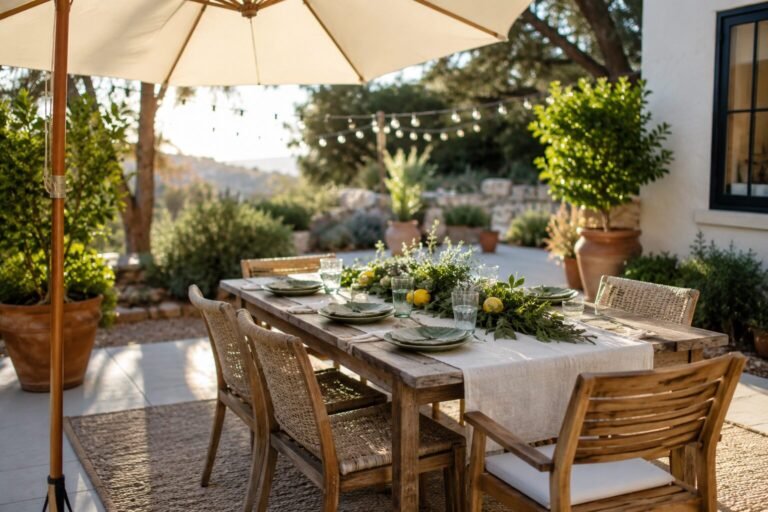
Sizing each zone: A 4-person lounge needs 8×10 feet of clear floor. A 6-person dining set needs about 10×10 feet with chair pull-back room. A fire pit zone needs the pit plus 4 feet of clear non-combustible surface in every direction. A cooking zone needs the grill plus 36 inches of prep space and 36 inches of clearance from anything combustible.
Transitions between zones: 36 inches of clear path between any two zones. Walking traffic shouldn’t cross sitting traffic — a path that runs in front of where people’s feet land when they sit on a sofa is annoying for everyone. Anchor each zone with a rug or distinct flooring so the zone reads visually as separate space.
Greenery and Privacy Without Bulk
Plants and privacy screens both add visual weight. On small patios, “without bulk” matters as much as which plants or screens to pick.
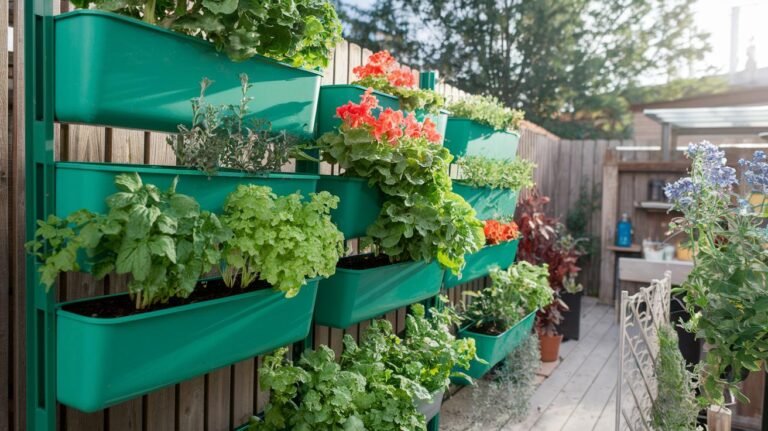
Vertical planting. A planter wall or fence-mounted herb panel adds greenery without consuming floor space. Train climbing vines on pergola posts so the structure doubles as a trellis. A row of tall narrow pots reads as a green wall but moves when you need the space back.
Privacy screens that don’t read as walls. Lattice with climbing roses or jasmine reads softer than solid panels. Bamboo screens give modern privacy at modest cost. Tall potted plants (clumping bamboo, columnar evergreens like Sky Pencil holly) screen sightlines without committing to a built structure. Outdoor curtains hung from a pergola pull open when you want the view back — see the outdoor curtains guide for hanging and fabric details.
Plant choices that fit small patios. Pick plants by mature size, not nursery size — a “small” shrub that grows to 6 feet wide eats half a small patio in three years. For container plants in compact patios: lavender (1-2 feet), dwarf catmint (1-2 feet), small-leaf ornamental grasses (2-3 feet), dwarf citrus in warm zones (3-4 feet), and standard-form rosemary trained tall (3-5 feet but narrow). Skip aggressive spreaders in small containers — mint and trailing rosemary look great until they take over.
Layered Lighting for Layout Clarity
Good patio lighting does three jobs at once: safety on walking paths, task lighting for cooking and reading, and ambient lighting that defines zones after dark. Layering different fixtures handles each job without one fixture trying to do all three.
Overhead. String lights across each zone (separate string per zone makes the zone visually distinct after dark). Warm-white LED (2700K) reads more like indoor light than commercial cool-white.
Task. A clip-on or pendant light over the dining table. Under-counter LED strip on any cooking prep surface. A small lamp on a side table near the reading spot.
Path and step. Low-voltage path lights along walking routes between zones. Stair risers get integrated LEDs or wall-mounted downcast fixtures. Brightness at foot level, not eye level.
Ambient. Solar stake lights along planter edges. Candle lanterns on tables. Uplighting at the base of tall pots or trees. These do the most for atmosphere and the least for actual visibility.
One layout note: lighting that’s mounted to the house (sconces, soffit lights) ties the patio visually to the building. Lighting that’s mounted to free-standing structures (pergola, planter posts) makes the patio read as its own space. Pick the effect that matches what you want.
Visual Tricks That Make a Patio Read Bigger
A handful of design moves make any small or awkward patio feel more spacious without changing its actual square footage.
Light, reflective surfaces. Pale pavers, white or cream walls, and light-colored pergola posts bounce light around and read more open than dark surfaces. The paver patio layout guide covers paver color choice in the context of overall surface design.
Diagonal layouts. Turning furniture or paver patterns 45 degrees off the patio’s edge creates longer sightlines diagonally across the space, which reads as more depth. Works especially well in square patios that feel boxy.
Scaled-down furniture. One armchair too big for the space makes the whole patio look cramped. Two correctly-scaled smaller chairs in the same footprint read as room. Apartment-scale furniture (32-inch-wide seats vs. standard 36-inch) costs about the same and saves visible square footage.
Tall vertical elements. A pergola, tall narrow plants, or wall-mounted shelves draw the eye up and shift attention away from the patio’s floor dimensions. Even a single tall planter at the edge of a small patio extends the visual space.
Continuous flooring with the house. If the patio surface matches or visually flows from indoor flooring, the two spaces read as connected — making the patio feel like an extension of the room rather than a separate small space.
Mirrors and reflective surfaces. An outdoor-rated mirror on a fence or wall doubles the visual depth of the patio. Stainless steel planters, dark-tinted water features, and reflective pavers all do smaller versions of the same trick.
Budget Layout Upgrades
Layout changes don’t have to cost much. Five upgrades that improve any patio for under $300 each:
- Add a rug. An outdoor polypropylene rug under the seating zone defines the zone, reads as intentional, and ties the furniture together. $50–$200 for residential sizes.
- Replace cushion covers. Solution-dyed acrylic in a new color refreshes the whole zone for $100–$200 instead of buying new furniture. The durable outdoor furniture guide covers fabric specs that hold up.
- Add string lights. Two strings of warm-white outdoor LED lights from corner to corner instantly improves the evening read of any patio. $40–$80 total.
- Add one tall planter. A single large pot with a tall plant changes the vertical profile of the space and adds greenery without a wall installation. $80–$200 for a pot plus plant.
- Reorient existing furniture. Free. Move the seating to face a better view, rotate the dining set 45 degrees, or pull furniture away from walls so it floats in the space rather than lining the edges.
The cumulative effect of these five upgrades is usually larger than people expect — a tired patio reads completely different with new fabric, a rug, lights, a planter, and a better arrangement.
FAQ
How do I lay out a small patio?
Pick two zones (typically lounge and dining, or lounge and fire) and skip the rest. Use apartment-scale furniture — 32-inch chairs instead of 36-inch. Keep 36 inches of clear walking space between zones. Anchor each zone with a rug. Add vertical elements (tall planters, pergola, string lights) to shift attention away from the floor’s footprint.
What’s the best layout for an L-shaped patio?
Treat each leg as its own zone. The longer leg usually handles dining; the shorter leg becomes the lounge zone. A corner sectional running along the inside of the L makes the corner read intentional rather than wasted. Keep 36 inches of clear walking space along the inside corner.
How much space do I need around a patio dining table?
30 inches of chair pull-back on each side where people sit, plus 24 inches at the ends. A 6-foot rectangular table needs roughly a 10×10-foot zone. A round table seats the same number in slightly less space because chairs distribute around the perimeter rather than concentrating on long sides.
How do I make a long narrow patio work?
One-row furniture only. Bench seating along the wall plus a narrow coffee or dining table out from the bench. Add a focal point at one end — a swing chair, hammock, or fire feature — so the long axis has somewhere to lead the eye. Skip any layout that requires people to sit on opposing sides of a single piece.
Should patio furniture be against the walls?
Not necessarily. Floating the furniture away from walls makes small patios read larger and breaks the “lined-up” feeling. For very tight spaces, pulling a sectional 6 inches off the wall is enough to create the floating effect without losing usable space.
What’s the minimum size for a useful patio?
About 80 square feet handles a bistro set for two or a single lounge chair plus a small side table. Below that, a patio reads more as a transitional space (stepping out from the door) than as a usable room. The smallest patios still benefit from a rug and string lights — both make even a tiny footprint feel intentional.
How do I make a concrete slab patio look better?
The single most-effective upgrade is a rug to break up the concrete visual. Beyond that: a fresh stain or sealer in a tone that complements the house, painted planters along the edges, and string lights overhead. A more involved upgrade is laying pavers or natural stone over the slab — the paver patio layout guide covers pattern and material choices.
Can I have a fire pit on a small patio?
Yes, with caveats. Fire features need at least 3 feet of clear non-combustible surface in every direction, 5 feet of vertical clearance, and a downwind position relative to seating. On patios under 150 square feet, a small gas fire table or chiminea makes more sense than a full open fire pit because the clearance requirements stay manageable.