Washers Toss Game Rules: Setup, Scoring, and Play
Washers toss is a straightforward backyard game that takes about five minutes to learn and can fill an entire afternoon. Two players or teams toss flat metal washers toward wooden target boards, score points based on where each washer lands, and use cancellation scoring to keep every round competitive until the final toss. The official rules are simple enough that anyone can play, and flexible enough to scale for different ages, spaces, and group sizes.
This guide covers everything you need to set up and run a proper washers toss game: equipment specs, court dimensions, the cancellation scoring system, turn order, fouls, win conditions, how to adapt the rules for casual play, and technique tips for improving your accuracy over time.
Official Washers Toss Game Rules
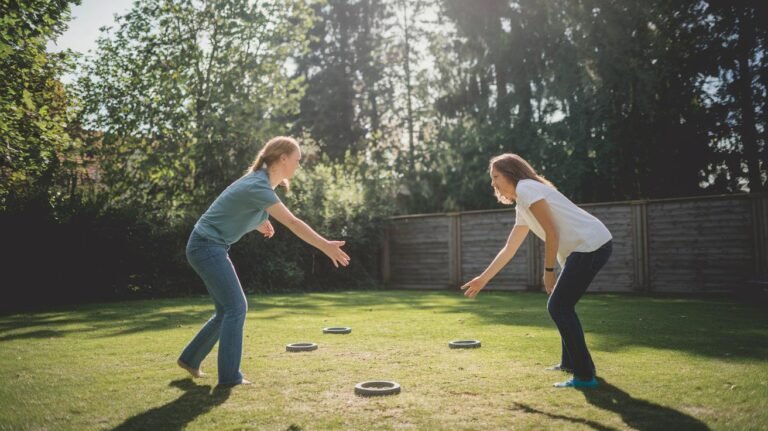
The standard game uses metal washers approximately 2 inches in diameter and 3 ounces each, and two wooden or coated boards featuring a centered 2.5-inch hole. Boards sit on level ground 20 feet apart for adult play. For younger players or casual backyard games, pulling the boards to 10–15 feet is common and keeps the game accessible without changing any other rules.
Players take turns tossing two washers per round toward the opposite board. A washer that falls through the hole scores 3 points — this is called a ringer. A washer that lands flat on the board surface scores 1 point. A washer that misses the board entirely scores 0. The side that wins a round tosses first in the next round.
| Landing Position | Points |
|---|---|
| Washer through the hole (ringer) | 3 |
| Washer resting on the board | 1 |
| Miss | 0 |
The match ends when one side reaches 21 points with at least a 2-point lead. If both sides reach 20, play continues until one side leads by two. This tiebreaker keeps close games competitive and prevents anticlimactic wins on a lucky single toss.
Do not step past the foul line — the line 20 feet from the target board — when tossing. Any washer thrown from beyond the foul line is worth zero points, even if it lands in the hole. Tossing out of turn carries the same penalty. Foul washers stay where they land until after the round’s points are tallied, since they can still cancel out an opponent’s scoring washer.
Equipment and Court Layout
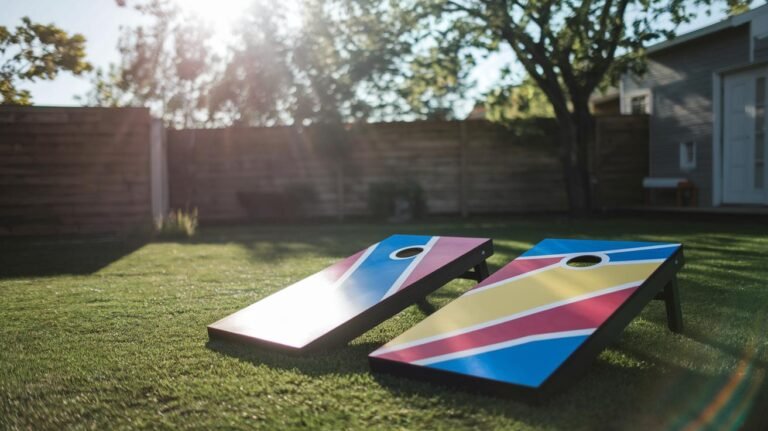
Most boards are cut from pine or cedar for a natural surface that holds up well outdoors. Some players use metal or plastic boards coated with a weatherproof finish to resist warping from sun and rain. The boards should lie flat on the ground — any tilt changes the bounce angle significantly and makes the game less consistent for both players.
Distance markers — small stakes or cones placed at the official 20-foot tossing line — keep foul-line placement accurate without requiring players to re-measure before each game. Many sets include folding boards and a carry bag, which makes transport to cookouts or parks easy. For setups requiring a similar level of court definition, the boundary-marking tips in the lawn Jenga safety guide apply well to washers toss too — especially the chalk-line and cone system for marking play zones.
If you’re building a broader outdoor game rotation, washers toss pairs naturally with other toss-and-score games. The outdoor ladder toss game guide covers a game with a similar setup footprint and skill curve — both run on the same principles of consistent release mechanics and strategic point management, so time spent practicing one transfers directly to the other.
Scoring System in Washers Toss
The scoring mechanic that defines washers toss is cancellation scoring. After both players toss their two washers, you don’t simply add up each side’s raw total. Instead, you first cancel equal-value washers against each other. Pair each ringer against an opposing ringer, and each on-board landing against an opposing on-board landing. Whatever remains after cancellation is the round score for the leading side. The trailing side scores nothing for that round.
Here’s an example: you land two ringers (6 points) and your opponent lands one on-board washer (1 point). There are no equal-value washers to cancel. Subtract 1 from 6 — you score 5 points for the round. Your opponent scores 0. In another round, if both players land one ringer each, those cancel out, and you look at remaining washers to determine the round score.
This system means that maintaining a lead requires consistent accuracy, not just a single good throw. A well-placed on-board landing can cancel an opponent’s ringer and shift momentum in the middle of a match. Keeping a running total on a chalkboard or in a scoring app eliminates score disputes and keeps the game moving. For a comparison of how similar points-difference scoring works in another classic outdoor game, see how to play horseshoes — the cancellation concept is nearly identical.
Turn Sequence, Fouls, and Win Conditions
Each player or team tosses two washers per round. The side that scored highest in the previous round throws first in the next one. In singles play, each player throws both of their washers before the opponent throws. In doubles, teammates alternate throws — one player from each team tosses, then the other player from each team tosses, until all four washers are in play.
Fouls occur when a player steps past the foul line during a throw, or when a player throws out of the established turn order. The washer from a foul throw scores zero regardless of where it lands, and it stays in place until scores are tallied for the round. This matters because a foul washer can still trigger cancellation against an opponent’s scoring washer — so leaving it on the board is not neutral.
The match ends when one side reaches 21 points with at least a 2-point lead. If the game reaches 20-20, it extends until someone builds a 2-point margin. There is no sudden-death format — both players still toss all washers in each extension round before checking if the lead condition is met.
Adapting the Rules for Different Players and Settings
The standard rules adapt easily for casual play, younger players, or different spaces. Shortening the board distance to 10–15 feet makes the game accessible for children and keeps rounds moving faster when you want a quick game between activities. For parties, setting the win condition to 15 points instead of 21 makes each game fit a shorter time slot.
You can also change washer or hole size to adjust difficulty. Larger washers are easier to land on the board. A slightly wider hole makes ringers more frequent, which suits beginners. A tighter hole demands more precision and works well for competitive play between experienced players.
If a wet board is making washers slide unpredictably, wipe it down with a towel or lay a tarp over it between rounds to keep the surface dry. Applying a coat of outdoor sealant to wooden boards at the start of each season extends the life of the surface and keeps it consistent through summer heat and autumn rain. Indoor play works fine on a garage floor — use chalk lines in place of boards and swap metal washers for soft foam rings to reduce noise and protect the floor.
Local recreational leagues often have their own house rules covering minimum board height, pit liner material, or official washer weight specs. If you’re playing in a tournament setting, confirm the local rules before the event rather than assuming the standard dimensions apply.
Strategy and Technique Tips
Hold the washer between your thumb and the first two fingers. The edge of the washer should rest against your fingertip pads, not your palm. Keep your grip relaxed — squeezing tightens the wrist and throws off release timing. Stand with feet shoulder-width apart, weight balanced, and knees slightly bent. Let your arm swing from the elbow like a pendulum and release at the same point on every toss. Consistent release point is more important than arm speed for accuracy.
Early in a match, prioritize on-board landings over going for ringers. A washer on the board scores 1 point and can cancel an opponent’s ringer, which effectively shifts 3 points in your favor. Once you’re ahead and your opponent is trying to catch up with ringers, targeted on-board shots can neutralize their biggest scoring opportunities.
Practice at three distances — 10, 15, and 20 feet — tossing five washers at each and tracking how many land on the board or in the hole. Then vary your release power: soft tosses that land at the front edge of the board, medium tosses that target the center, and firm tosses that reach the back edge. The goal is to land cleanly anywhere on the board surface on demand, so you can adjust for wind or a slightly uneven lie. Place two washers on the board and practice knocking them off — this develops the precision needed for cancellation plays in competitive rounds.
Wind affects washer flight more than most players expect. In a crosswind, aim slightly upwind and let the breeze carry the washer back toward the target. Low-arc tosses — keeping the washer closer to waist height through the swing — are less affected by gusts than high-arcing throws. If you’re playing on uneven turf, check how the board sits before each round; a slight tilt changes landing angles and can make on-board washers slide off unexpectedly.
With consistent release mechanics, smart point management using cancellation, and a little time practicing at different distances, washers toss goes from luck-based to skill-driven quickly.
Choosing a Washer Toss Set
As an Amazon Associate, Backyard Superstar earns from qualifying purchases at no extra cost to you.
A good washer toss set lives or dies by the build. A solid wooden washer toss set with well-made boxes (or a recessed cup) and properly weighted washers gives you the satisfying clunk and consistent toss that the thin metal-only sets can’t match. Look for sanded, sealed wood that stands up to dew and a set that includes a full complement of washers in two colors. A sturdy box set doubles as its own carry case, which makes it easy to stash in the garage and haul out for the next cookout.
Frequently Asked Questions About Washers Toss
What equipment do I need to play washers toss?
You need metal washers approximately 2 inches in diameter (about 3 ounces each), two target boards with 2.5-inch centered holes, a level playing surface, and foul-line markers placed 20 feet from each board.
How do I set up a regulation washers toss court?
Place two boards flat on level ground 20 feet apart, with foul lines marked at that same distance from each target. For casual or youth play, shorten the distance to 10–15 feet without changing any other rules.
How is scoring calculated in washers toss?
A washer through the hole scores 3 points, a washer resting on the board scores 1 point, and a miss scores 0. After both sides toss, equal-value washers cancel each other out, and only the net difference counts toward the leading side’s total for that round.
What is cancellation scoring in washers toss?
Cancellation scoring pairs each side’s equal-value washers and zeroes them out before counting the remainder. Only the side with the higher remaining total scores points for the round, and the margin — not the raw total — is what gets added to the match score.
How do turns work and what counts as a foul?
Players alternate rounds of two washers each, with the previous round’s high scorer throwing first. Stepping past the foul line or tossing out of turn makes that washer worth zero points. Foul washers stay on the board and can still trigger cancellation until scores are tallied.
How do I win a washers toss match?
Reach 21 points with at least a 2-point lead. If both sides reach 20, play continues until one side leads by two. Both players complete all their tosses in each extension round before checking the lead condition.
Can I change the rules for casual or youth play?
Yes. Common casual adjustments include shortening board distance to 10–15 feet, changing the win target to 15 or 31 points, using larger washers or a wider hole for younger players, and letting latecomers join at 10 points so they’re not playing catch-up the entire game.
What are the best technique tips for accurate washer tossing?
Hold the washer lightly between fingertip pads, use a pendulum swing from the elbow, and release at the same point on every toss. Practice at 10, 15, and 20 feet with varied power levels. Prioritize on-board landings early to build points through cancellation before going for ringers.