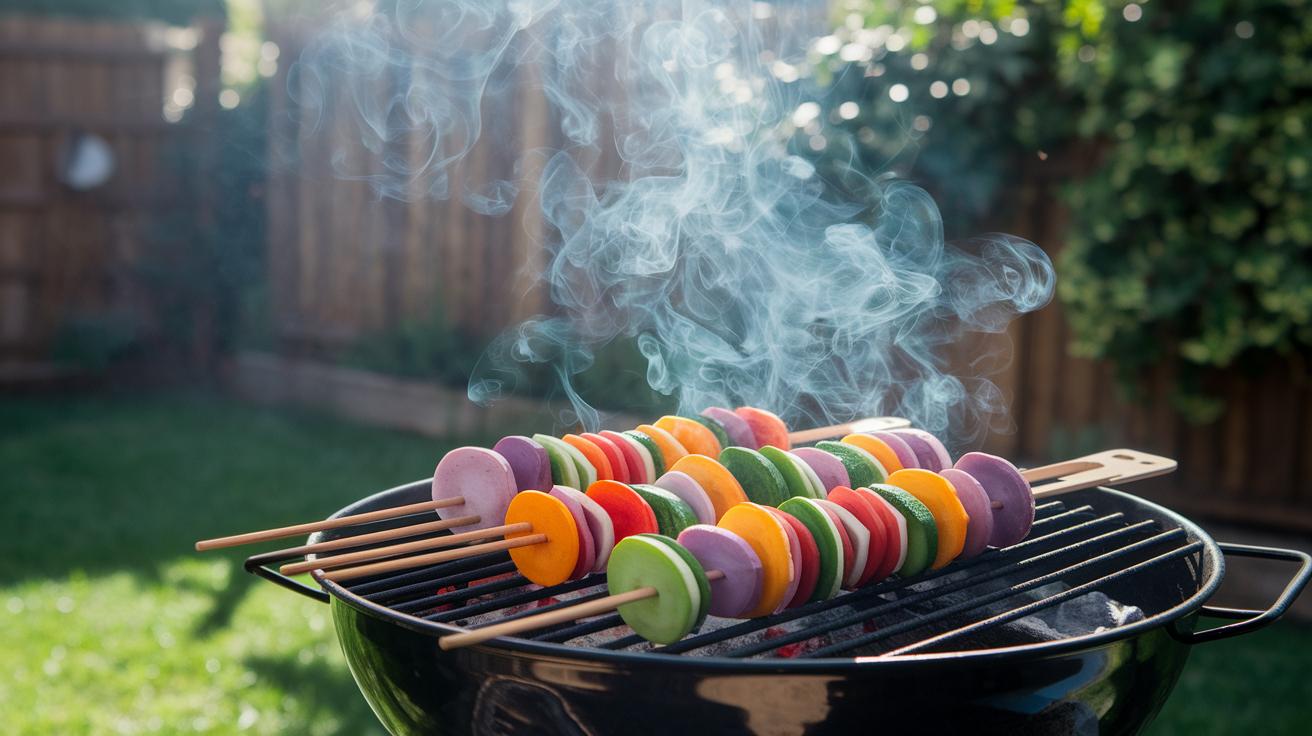
Charcoal-Grilled Vegetable Skewers Recipe
Vegetable skewers are the rare grilling project where the result genuinely improves on what you’d get from the same vegetables cooked any other way. Charcoal heat caramelizes pepper sugars, blisters tomato skins, and pushes mushrooms past their watery raw stage into something concentrated and meaty. The technique is straightforward once you know two things: how to cut the vegetables so they finish together, and how to manage charcoal heat so the outside chars without leaving the inside raw.
This guide covers ingredient selection, prep, a simple base marinade (with a pointer to deeper marinade variations), charcoal heat setup, assembly, grilling technique, and troubleshooting the common problems — flare-ups, uneven cooking, undercooked mushrooms.
Ingredients and Vegetable Prep
Five vegetables form the backbone of a good skewer set. They cook in roughly the same time and contrast in color and texture.
- Bell peppers — sweet, holds shape under heat, vivid color. Red, yellow, and orange peppers grill sweeter than green.
- Zucchini — mild flavor, picks up smoke and marinade well. Slice into rounds about a quarter-inch thick.
- Cherry tomatoes — burst with juice when blistered. Whole works; halved is fine for the large grape varieties.
- Red onion — sharp raw, sweet grilled. Cut into 1-inch wedges with two or three layers per wedge so they hold together on the skewer.
- Portobello or large cremini mushrooms — meaty texture and earthy flavor. Quarter portobellos; halve creminis. Whole white button mushrooms are too watery for skewers.
The size-matching rule
Cut every vegetable to roughly 1 to 1.5 inches. This is the most common skill mistake — different-sized pieces finish at wildly different times, leaving you with mushy peppers next to undercooked mushrooms or vice versa. Equal size means equal cook time.
One exception: cherry tomatoes stay whole because they grill in 3 to 5 minutes and bursting is the point. Add them to the skewer on the outside positions if you want to remove them early.
Optional ingredients worth considering
- Pineapple chunks — caramelize beautifully and pair surprisingly well with peppers and onion.
- Halloumi or paneer cubes — both hold shape under heat and add protein. Cut to match vegetable sizing.
- Eggplant rounds — works if cut thin (1/4 inch) and salt-drained 15 minutes first to pull excess moisture.
- Asparagus spears — woody bottom trimmed, threaded perpendicular across two skewers for stability.
The whole skewer set for four people needs roughly: two bell peppers, one medium zucchini, a pint of cherry tomatoes, one medium red onion, and four portobello caps. That makes 8 to 12 skewers depending on how densely you thread.
A Simple Base Marinade (and Where to Go Deeper)
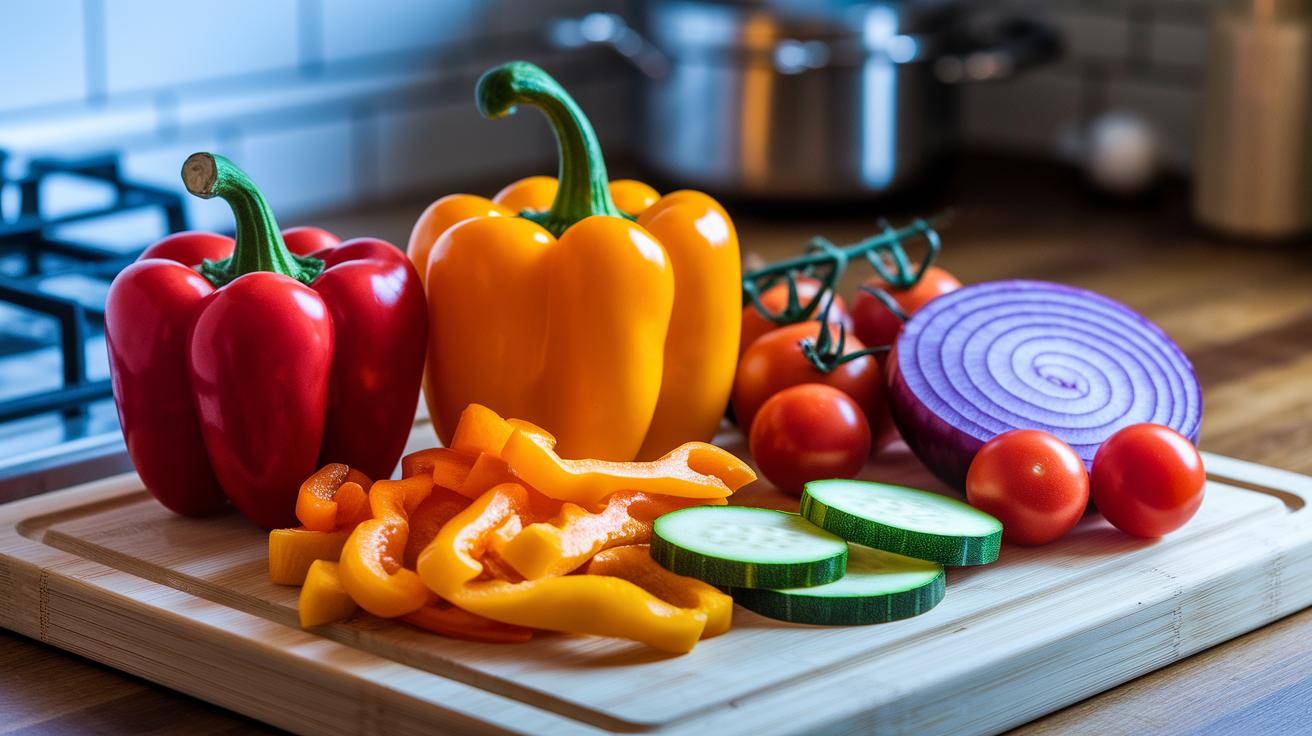
The base marinade is olive oil, balsamic vinegar, garlic, oregano, salt, and pepper. Simple, balanced, and works with any vegetable combination.
Base marinade (makes enough for 8 skewers):
- 1/4 cup good olive oil
- 2 tablespoons balsamic vinegar
- 2 cloves garlic, minced
- 1 teaspoon dried oregano (or 1 tablespoon fresh, chopped)
- 1/2 teaspoon kosher salt
- 1/4 teaspoon black pepper
Whisk in a bowl. Toss the cut vegetables in the marinade and let them sit for 30 minutes at room temperature or up to 4 hours covered in the fridge. Longer marinating doesn’t help vegetables the way it helps meat — past a few hours, the salt starts to draw moisture out of zucchini and tomatoes and the result is mushy.
If you want more variety than the base recipe — soy-umami, smoky paprika, herb-citrus, or Thai peanut versions — see our companion guide on best marinades for grilled vegetable skewers, which covers four flavor variations and timing notes specific to each.
Setting Up Charcoal for Even Heat
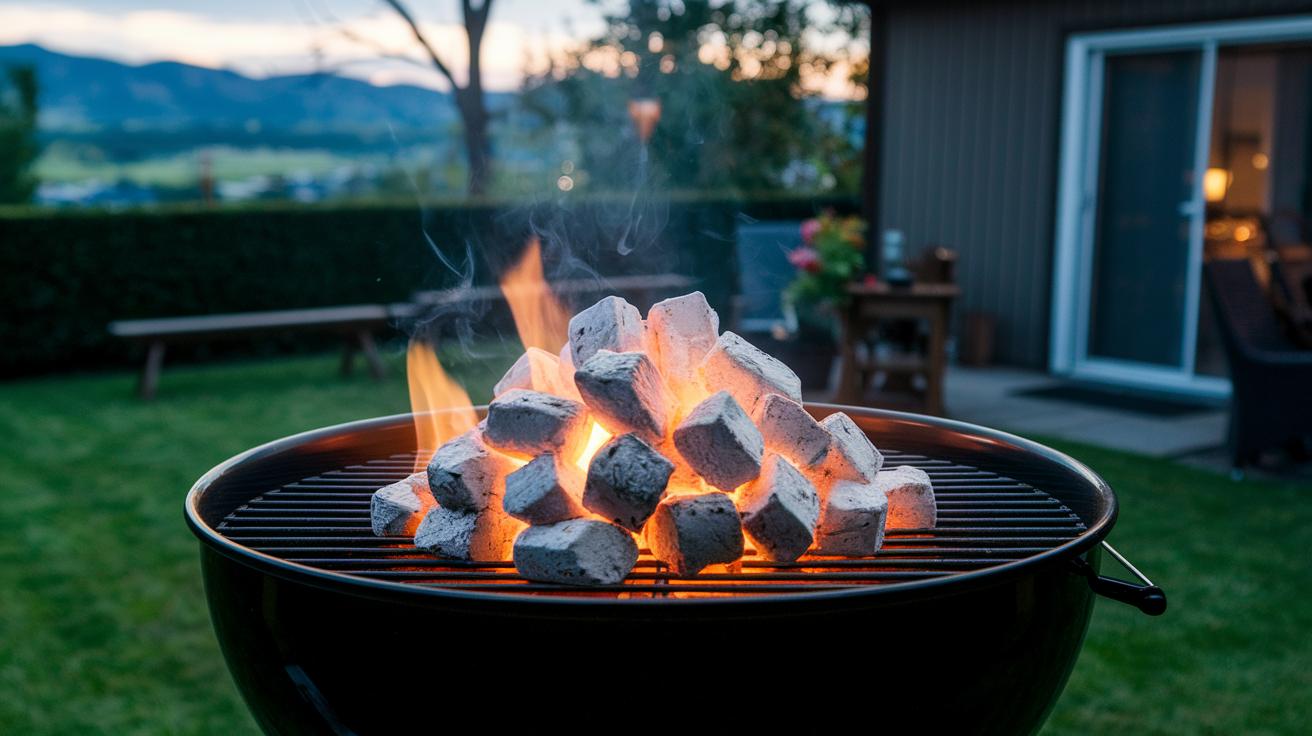
Charcoal beats gas for vegetable skewers because of one thing: the higher dry heat caramelizes vegetable sugars in a way a gas grill rarely can. The setup is straightforward.
- Fill a chimney starter with about 30 briquettes (or an equivalent volume of lump charcoal). The chimney is a $15 metal tube that lights coals evenly in 15–20 minutes without lighter fluid. If you don’t have one, a few crumpled newspaper sheets at the bottom of a pile of coals works.
- Light and wait. The coals are ready when they glow red-orange under a coat of white-gray ash. Don’t grill on black coals — they’re not hot enough yet and they smoke unpleasantly.
- Pour coals into a two-zone setup. Pile coals on one side of the grill, leaving the other side empty. This gives you a direct-heat zone (over coals) for searing and an indirect-heat zone for finishing or cooling off flare-ups.
- Open the vents. Bottom vent and top vent both about half-open. This gives steady airflow at roughly 350–400°F at the cooking surface.
- Hand test. Hold your palm 5 inches above the grate. If you can keep it there for 4 to 5 seconds, you’re at medium-high heat — the right zone for vegetables. Less than 3 seconds is too hot (vegetables char before they cook through). More than 7 seconds is too cool (they steam instead of grill).
Briquettes burn for 45–60 minutes at this temperature. Lump charcoal burns hotter and faster, usually 30–45 minutes. For a typical skewer cook of 12–15 minutes, either works.
Assembly and Skewer Technique
How you thread the skewers matters. Sloppy threading means uneven cooking and dropping vegetables through the grate.
Choose your skewer type:
- Metal skewers conduct heat through the vegetables, which speeds cooking from the inside and improves doneness consistency. They’re reusable and indestructible. The flat-bladed style (1/4-inch wide) stops vegetables from spinning when you turn them, unlike round skewers.
- Wooden or bamboo skewers are disposable and inexpensive. Soak them in water for at least 30 minutes before use or they’ll catch fire on the grill. Even soaked, the exposed ends darken — that’s normal.
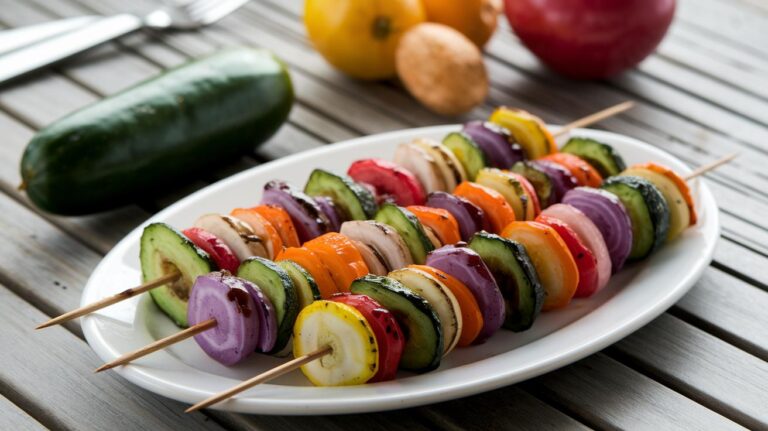
Threading pattern. Alternate vegetables for visual contrast and to spread the cooking load evenly. A repeating sequence: zucchini, pepper, mushroom, onion, cherry tomato. Then repeat. Each skewer gets 5–7 pieces depending on length.
Leave about a quarter-inch gap between pieces. Tight-packed skewers steam instead of grill — the vegetables don’t get the direct heat exposure that creates char. Loose-packed skewers char unevenly because some sides hide from the flame.
Put cherry tomatoes on the outside ends of the skewer if you can. They cook fastest and you’ll want to pull them off (or accept they’ll burst) before the heartier vegetables are done.
Grilling the Skewers
The actual grilling phase is short — 12 to 15 minutes total — but how you handle the heat matters more than the timer.
- Oil the grate first. Fold a paper towel into a thick pad, dip in vegetable oil, and rub the grate with tongs. This prevents the vegetables from sticking when you place and turn them.
- Place skewers over the coals (direct heat zone). Lay them perpendicular to the grate bars so they’re well-supported.
- Cook 3 minutes per side, turning every 3–4 minutes. Total cook time is 12 to 15 minutes for full doneness. You’ll get four turns on a skewer that has four flat sides.
- Watch for flare-ups. Marinade drippings can flame up briefly. If flames touch the vegetables for more than a few seconds, slide the skewers to the indirect-heat zone for a minute, then back.
- Brush extra marinade on each turn. Use a separate brush (and bowl) of marinade than what touched raw food. Or set aside half the marinade before tossing the vegetables for safe basting.
- Test doneness on the thickest pepper. Press with tongs — it should yield slightly but still hold its shape. Zucchini should be tender but not collapsing. Tomato skins should be blistered and starting to crack.
Pull the skewers off when the densest vegetables (peppers, mushroom chunks) are just tender. Vegetables continue cooking from residual heat for a couple minutes after they leave the grill, so slight underdone is fine — overdone is hard to come back from.
Serving, Pairing, and Storing
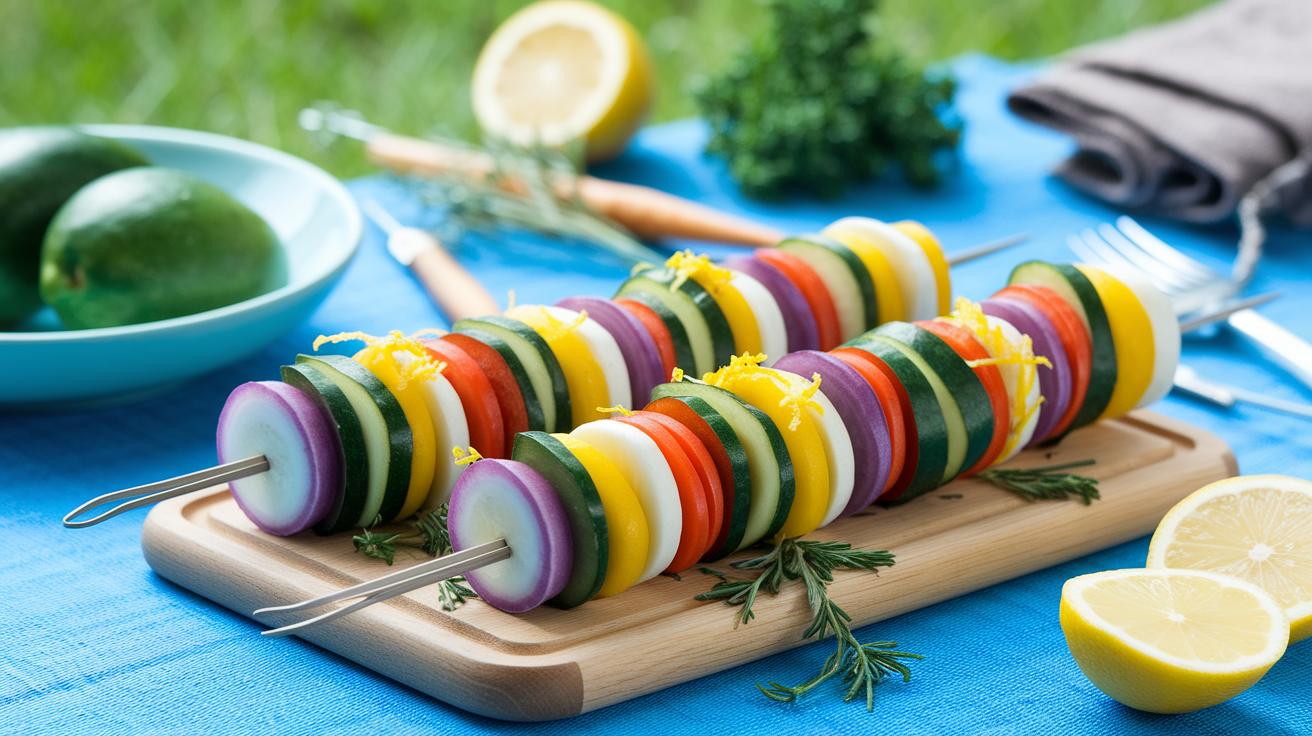
Serving moves that punch above their effort:
- Sprinkle a handful of chopped fresh herbs (parsley, basil, cilantro) over the platter just before serving. Heat releases the herb oils and lifts every bite.
- Squeeze fresh lemon over the warm skewers right before serving. The acid wakes up the smoky-sweet base.
- Set out a dipping sauce on the side — garlic yogurt, tahini-lemon, or chimichurri. Half the appeal is the dunk.
- Crumble feta or grated Parmesan over the hot vegetables. The cheese softens but doesn’t melt entirely.
Pairing. Vegetable skewers work as a main course with rice or flatbread, as a side to grilled chicken or fish, or as the centerpiece of a meze-style spread with hummus, olives, and bread. They’re vegan as drafted (the base marinade has no animal products), which makes them useful for mixed-diet gatherings.
Storing leftovers. Pull the vegetables off the skewers and store in an airtight container in the fridge for up to 4 days. They lose textural pop when chilled but are excellent cold in a salad or quickly reheated on a hot pan. Don’t microwave — turns peppers rubbery.
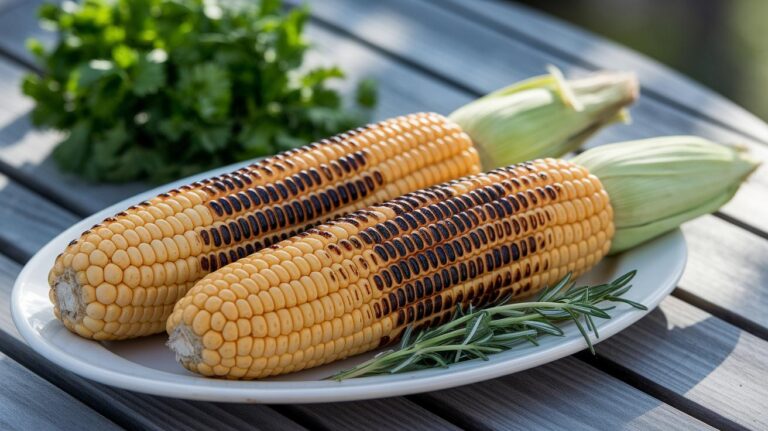
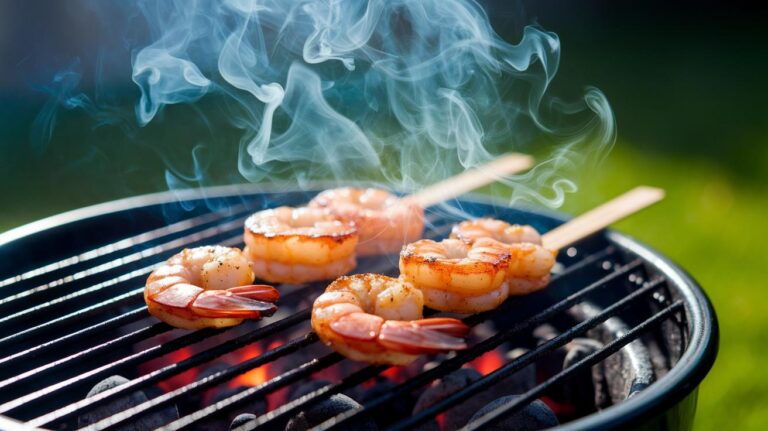
For the rest of the grilling lineup that pairs naturally with skewers, see our walkthroughs on grilled corn on the cob and charcoal-grilled shrimp. All three work over the same fire setup, which makes for an efficient grilling session.
Troubleshooting Common Problems
Three problems show up in most first-time skewer attempts. Each has a quick fix.
Flare-ups blackening the vegetables. Cause: marinade drippings hitting hot coals. Fix: slide skewers to the indirect-heat zone for 30 seconds, brush off any blackened spots with a paper towel, and shake excess marinade off skewers before placing on the grill. Going forward, drain skewers briefly on a plate before grilling.
Mushrooms still raw when peppers are done. Cause: mushroom chunks too large relative to other vegetables. Fix: cut mushrooms 25% smaller than other pieces. Mushrooms hold less heat than the firmer vegetables and need that compensation.
Zucchini collapses into mush. Cause: cut too thin, or over-marinated. Fix: cut zucchini in quarter-inch (not paper-thin) slices, and limit marinating time to 4 hours maximum. Salt in the marinade draws water from zucchini cell walls beyond that point.
Vegetables sticking to the grate. Cause: grate not oiled before cooking. Fix: oil the grate as described in the grilling section. Don’t try to pry stuck vegetables free — let them release naturally as they char (usually within 30 seconds), or accept the loss and move on.
Grilling vegetable skewers becomes routine after one or two tries. Once the technique is in your hands, you can swap in whatever vegetables are in season — eggplant in late summer, butternut squash chunks in fall, asparagus in spring — and the same heat management and timing approach carries forward.
A few tips that don’t fit anywhere else
Three habits worth picking up that don’t get covered in most skewer recipes:
- Double up wooden skewers for stability. When you have heavier vegetables (like portobello chunks) threading next to lighter ones (like tomatoes), the skewer can rotate on the grate and you can’t flip cleanly. Run two parallel skewers through the same vegetables, about an inch apart, and the whole thing becomes a flat panel that flips as one piece. Standard pro-grill technique that home cooks rarely use.
- Pre-cook the densest vegetables briefly. Butternut squash, hard sweet potato, or whole garlic cloves don’t cook through in the 12-minute window. Microwave them for 90 seconds before threading, or par-boil for 3 minutes. Then they finish at the same time as everything else.
- Build a separate “tomato” skewer. If you want lots of cherry tomatoes, don’t mix them onto the same skewer as everything else — they cook in half the time and you’ll either pull them too early (other vegetables raw) or too late (tomatoes collapsed). Put them on their own skewers and grill 5 minutes total.
- Save the marinade for a finishing drizzle. Reserve about a quarter cup of the original marinade before tossing the vegetables. Warm it briefly and drizzle over the platter at serving — the fresh, uncooked acidity brings the dish back to life after the heat of grilling has mellowed everything.
Vegetable Skewers FAQ
What vegetables work best for charcoal grill skewers?
Bell peppers, zucchini, cherry tomatoes, red onion, and portobello or large cremini mushrooms form the standard backbone. They cook in similar times and contrast in color and texture. Optional additions: pineapple, halloumi or paneer, eggplant (thin-cut and salt-drained first), and asparagus spears.
How long should I marinate vegetable skewers?
30 minutes at room temperature is enough for the marinade to coat. Up to 4 hours covered in the fridge deepens flavor. Past 4 hours, the salt in the marinade starts pulling moisture out of zucchini and tomatoes and the result turns mushy. Vegetables don’t benefit from overnight marinades the way meat does.
What charcoal grill temperature is best for vegetable skewers?
Medium-high heat at 350–400°F. To check without a thermometer, hold your palm 5 inches above the grate — 4 to 5 seconds of comfort is the right zone. Set up a two-zone fire (coals on one side, empty space on the other) so you can slide skewers to the cooler zone if flare-ups happen.
Should I use wooden or metal skewers?
Metal skewers conduct heat through the vegetables, speeding inside cooking and improving doneness consistency — flat-bladed metal is the gold standard since the vegetables don’t spin when you turn them. Wooden skewers are cheaper and disposable but must be soaked in water for 30+ minutes before grilling to prevent fire.
How do I prevent flare-ups when grilling vegetable skewers?
Drain excess marinade off skewers on a plate for a minute before placing them on the grill. Use a two-zone fire so you can slide skewers to the indirect-heat zone if flames rise. If a flare-up does happen, move skewers off the hot spot for 30 seconds, then back. Brush off any blackened marinade spots with a paper towel.
Can I make vegetable skewers ahead of time?
Pre-thread skewers and store covered in the fridge for up to 24 hours before grilling. The marinade keeps doing its work in the fridge. For leftovers, pull vegetables off the skewers and store in an airtight container for up to 4 days. Reheat in a hot pan rather than the microwave.